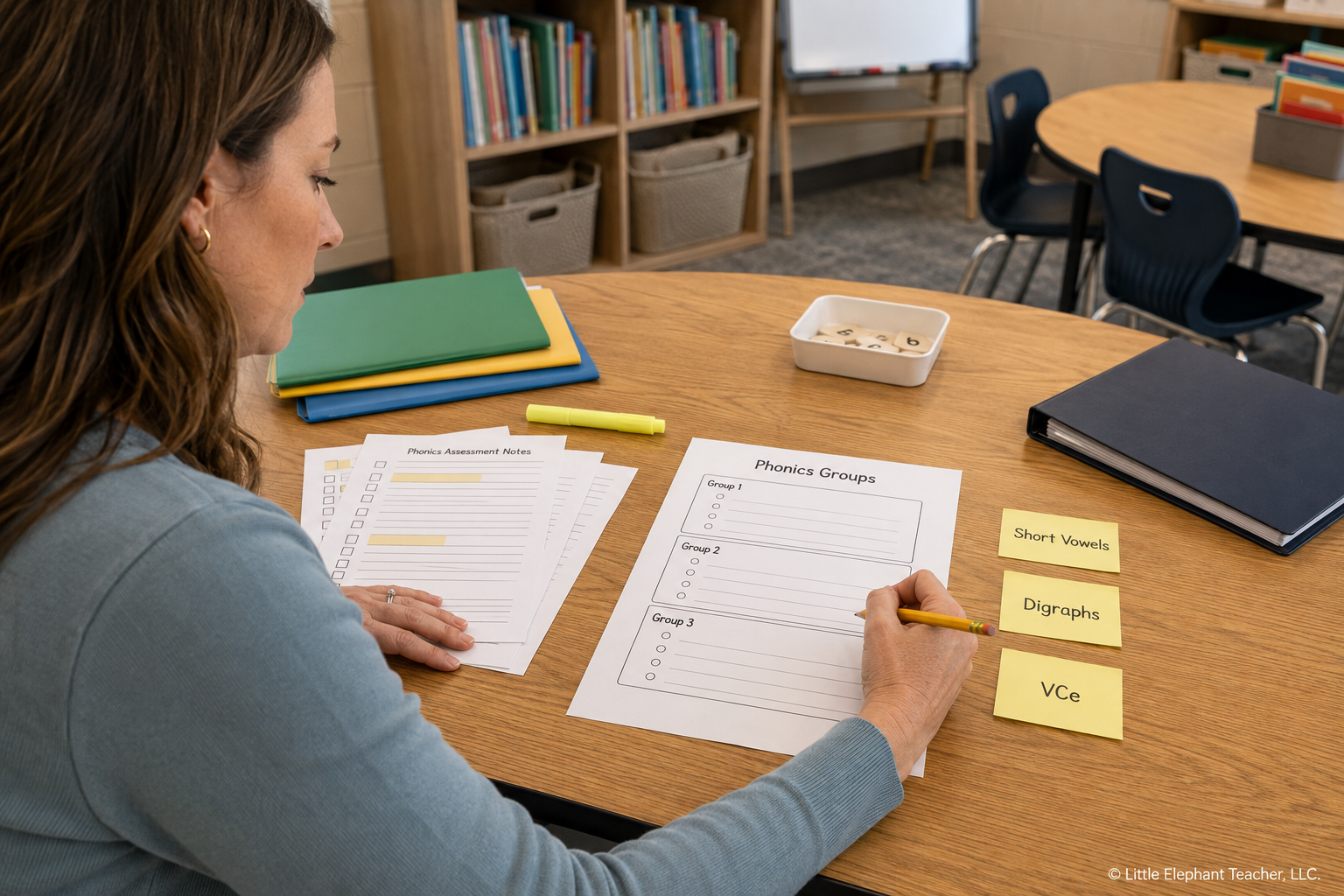
Assessment scores are a starting point. The most useful phonics intervention groups are built around the specific skill needs students share.
You administered the assessments. You highlighted the skills each student missed. You may even have a general idea of where each student is struggling.
Then you spread the assessment papers across the table and realize you still have a problem: eight students, eight slightly different profiles, and only a few intervention blocks in which to teach them.
Who should be in a group together?
This is where grouping students using assessment data becomes more complicated than sorting papers by reading level or total score. The results give you useful information, but they do not automatically tell you how to group students for phonics intervention.
As a Title I reading teacher, I have seen strong, explicit lessons feel ineffective simply because the students sitting at the table did not need the same instructional focus. One student required support with an earlier skill. Another had already mastered the target. A third needed the lesson, but required a different level of prompting and practice.
The problem was not necessarily the lesson—or the teacher delivering it. The group itself was not well matched for that instruction.
Before forming intervention groups, first confirm which students demonstratereading and spelling behaviors that point to a foundational phonics need. Once you know which students need foundational support, you can begin thinking about who may benefit from instruction together.
How should students be grouped for phonics intervention?
Group students around a related phonics need rather than a reading level or total assessment score alone. Consider the skills students have been taught, patterns in their reading and spelling, and the amount of support they require. Groups should remain flexible as student needs change.
Why Assessment Scores Do Not Automatically Create Effective Phonics Intervention Groups
A total score can tell you that a student experienced difficulty. It cannot always tell you why.
Imagine that a student reads 16 out of 20 words correctly. That score does not tell you whether the student:
Repeatedly confused one particular vowel sound
Read accurately but very slowly
Applied the pattern while reading but not while spelling
Needed prompting before reading several words
Used the skill in isolation but lost it in connected text
Demonstrated an inconsistent skill rather than a completely missing one
Each of those details changes what you understand about the student’s performance.
This does not mean the total score is unimportant. It means the score is only one part of the instructional picture. When we form phonics intervention groups from that number alone, we risk grouping students whose difficulties look similar on paper but require different instruction at the table.
Phonics data should do more than place students into broad groups—it should help teachers understand the instructional needs hidden behind the score.
Why Reading Level Alone Is Not Enough for Phonics Grouping
Reading levels can provide helpful context. They may show that a text is difficult for a student or that the student needs additional reading support.
What a reading level does not reveal is the exact phonics pattern creating the difficulty.
Two students may be assigned the same reading level, yet one may struggle to blend CVC words while the other can decode single-syllable words but has difficulty applying syllable patterns to longer words. Both students may be considered “below grade level,” but that label does not make them a well-matched phonics group.
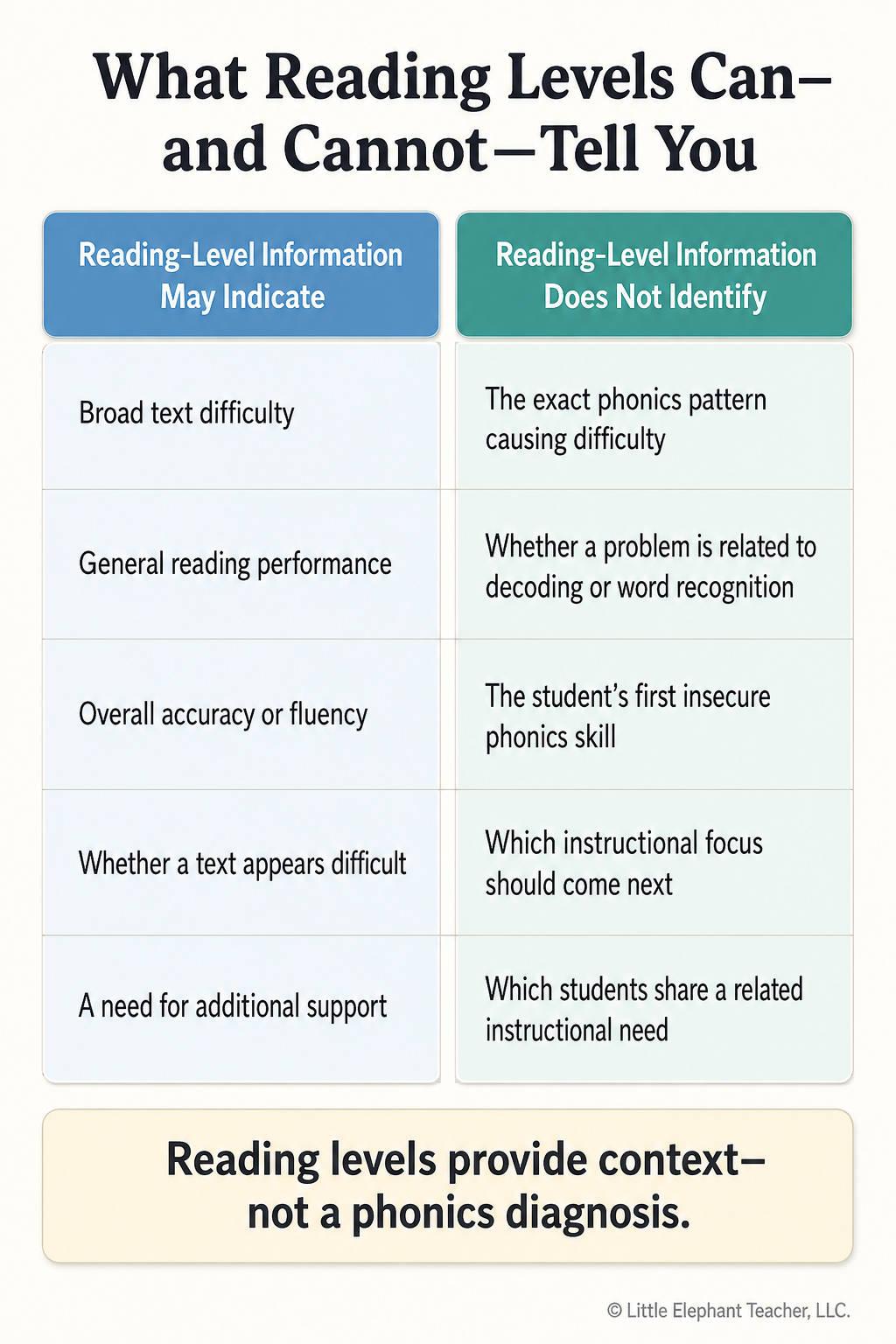
Reading-level information may indicate
Broad text difficulty
General reading performance
Overall accuracy or fluency
Whether a text appears difficult
A need for additional support
Reading-level information does not identify
The exact phonics pattern causing difficulty
Whether a problem is related to decoding or word recognition
The student’s first insecure phonics skill
Which instructional focus should come next
Which students share a related instructional need
Reading level describes broad performance. Phonics intervention requires us to look more closely at the foundational skills underneath that performance.
Why Students With the Same Phonics Score May Need Different Instruction
Mia and Jordan each earn 16 out of 20 on the same phonics assessment.
Mia repeatedly confuses short-vowel sounds. She reads pet as pit and map as mop. Jordan reads the words correctly, but he pauses for a long time and looks to the teacher before responding.
Their scores look the same. What the teacher observes does not.
Mia’s errors show a repeated vowel pattern. Jordan demonstrates accuracy, but not the same level of independence or automaticity. Grouping them together based only on the total score could lead the teacher to assume they need the same instructional focus.
This is why it is important to look beyond how many words a student missed. Looking closely at the words a student misreads can reveal information that the total score may hide.
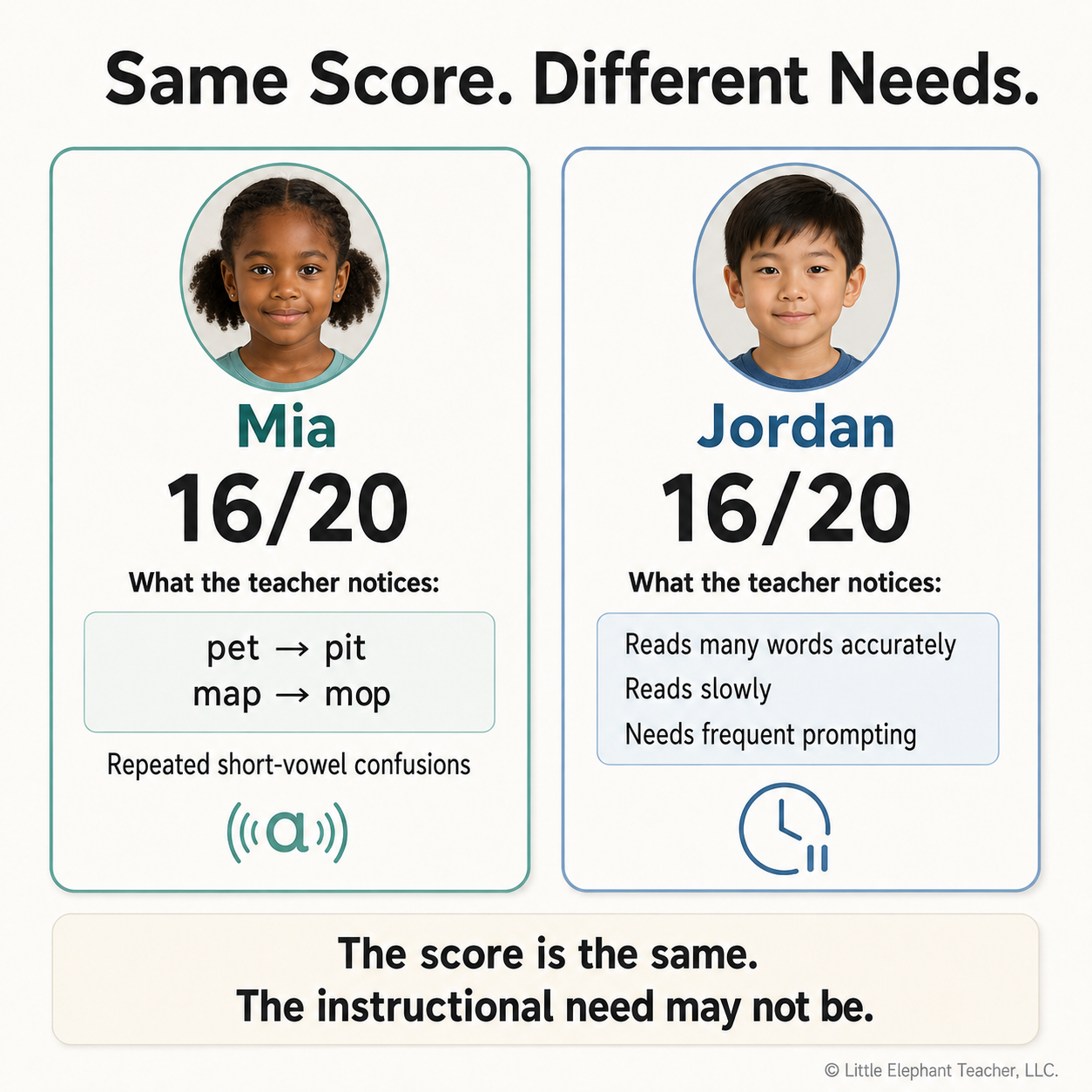
Students can earn the same phonics assessment score for very different reasons. Error patterns and reading behaviors reveal more about instructional needs than the total score alone.
What Information Should Influence Phonics Grouping Decisions?
When you are considering which students may benefit from instruction together, no single piece of information should make the entire decision.
Look broadly at what you noticed during assessment and instruction:
Decoding: What happens when the student reads unfamiliar words containing the target pattern?
Spelling or encoding: Can the student represent the sounds with the expected letters or spelling pattern?
Repeated error patterns: Do the student’s errors point to a particular confusion, or do they appear unrelated?
Accuracy: Does the student apply the skill correctly?
Automaticity: Is the response reasonably efficient, or does the student need considerable time to work through each word?
Previously taught skills: Has the student received instruction in the skill being assessed?
Connected-text application: Does the skill remain available when the student reads sentences and passages?
Prompting: How much teacher support does the student need before responding successfully?
These categories help you see that two students can arrive at the same score in very different ways. They also help explain why one student may respond successfully to a group lesson while another student at the same broad reading level does not.
The goal here is not to make a placement decision from one observation. It is to recognize that meaningful reading intervention grouping requires more than sorting students by one number.
What Should Students in a Phonics Intervention Group Have in Common?
Students in a phonics intervention group should share a related instructional need rather than simply a similar overall performance level.
The word related matters.
Students do not need identical assessment profiles. They may differ in speed, confidence, the amount of review they need, or their performance on individual words. One student may require an additional model, while another is beginning to work more independently.
However, the group’s primary phonics focus should be appropriate for every student sitting at the table.
For example, students working on consonant digraphs may make different errors and progress at slightly different rates. They may still benefit from instruction together if consonant digraphs are an appropriate focus for each student and everyone has the prerequisite skills needed to participate in the lesson.
Before looking for shared group needs, it helps to understand how the first insecure phonics skill can influence the instructional starting point.
Three Questions to Ask About Your Phonics Intervention Groups
You do not need to rebuild every group today. Start by examining the groups you already have.
1. Can I State This Group’s Primary Goal in One Sentence?
Try finishing the sentence:
This group is working on __________.
A focused answer might be:
This group is learning to decode words containing consonant digraphs.
This group is building accuracy with VCe words.
This group is applying closed-syllable decoding to two-syllable words.
If your answer includes several unrelated phonics patterns, comprehension strategies, fluency goals, and spelling needs, the group may be trying to accomplish too much at once.
A clear goal helps you select examples, prompts, decoding practice, spelling work, and connected text that reinforce the same instructional focus.
2. Do Students Have the Prerequisite Skills Needed for This Instruction?
A student may appear to struggle with the current lesson when the actual difficulty begins with an earlier skill.
During a VCe lesson, for example, one student may still be working to read short-vowel CVC words accurately. Another may read VCe words immediately and be ready to apply the pattern in connected text.
Both students may be below grade level, but they are not entering the lesson with the same foundation. The first student is trying to manage an earlier need while also learning the new pattern. The second student may spend much of the lesson waiting.
You do not need every student to perform identically. You do need to consider whether the foundational skills required for the lesson are available to everyone.
3. Are Students Responding Similarly Enough to Benefit From the Same Lesson?
Think about what happens while you teach.
Does one student require substantially more prompting than everyone else? Is one student consistently lost? Are two students ready to move forward while another needs a different explanation and considerably more practice? Has one student already mastered the group’s focus?
A little variation is normal. A pattern of students needing substantially different instruction is worth noticing.
If you cannot answer yes to these three questions, the group may need a closer look.
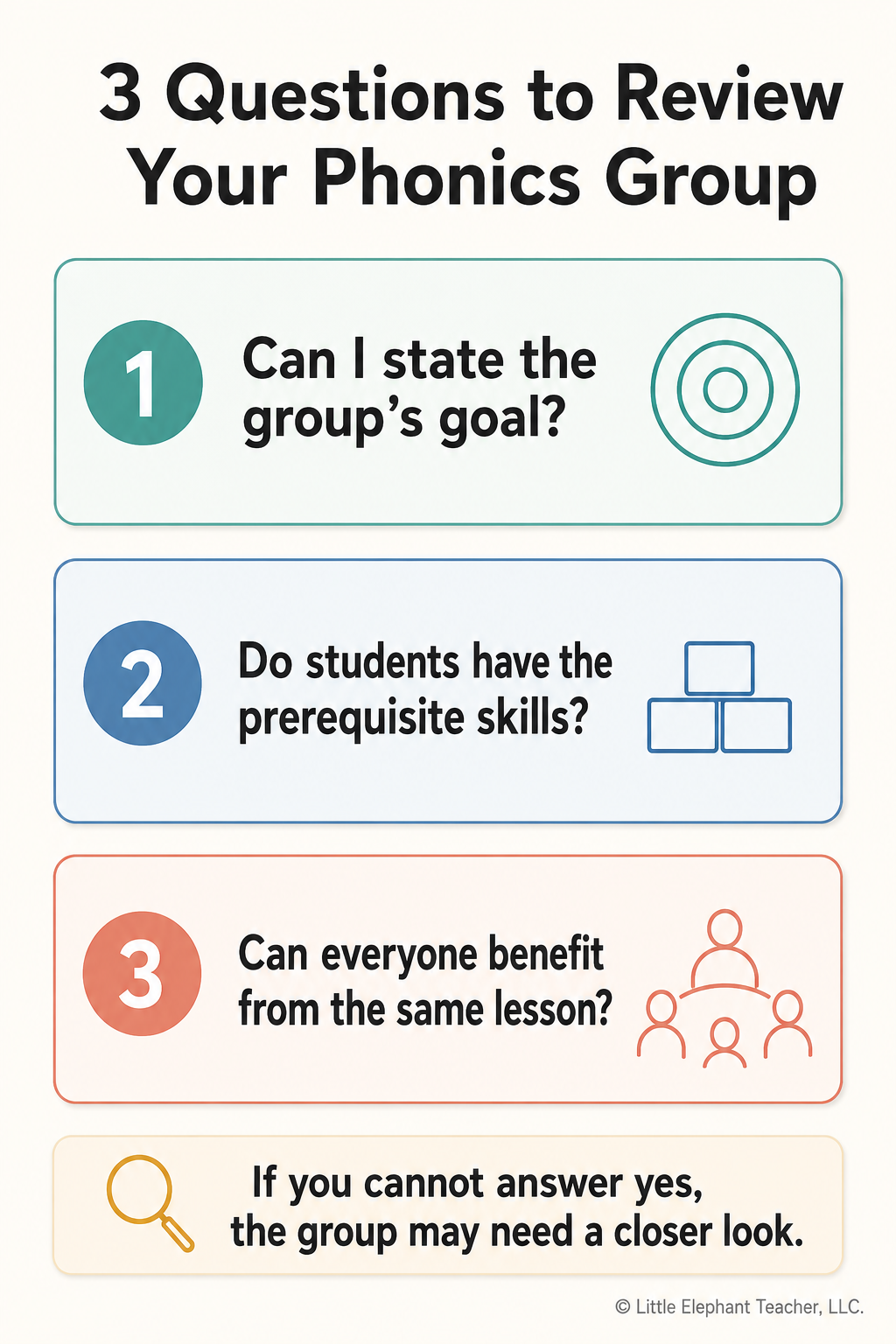
A strong phonics intervention group has a clear instructional goal, includes students with the necessary prerequisite skills, and provides a lesson that benefits everyone at the table.
Why Perfectly Matched Groups Are Rare
In a real intervention schedule, students rarely sort themselves into perfect categories.
You may have limited intervention periods, uneven group sizes, students from different grade levels, and overlapping needs. One student may not fit neatly into any existing group. Another may need the same phonics focus as the group but require more repetition.
Effective grouping is not about creating perfect groups. It is about creating groups that are focused enough for the instruction to be useful to everyone.
Students from different grades may sometimes work together when they share a related foundational need and the instruction and materials remain age-respectful. Grade placement provides context, but it should not automatically outweigh the skill students need to learn.
Research summarized by Reading Rockets also supports using varied and flexible grouping formats to respond to students’ skills and prior knowledge.
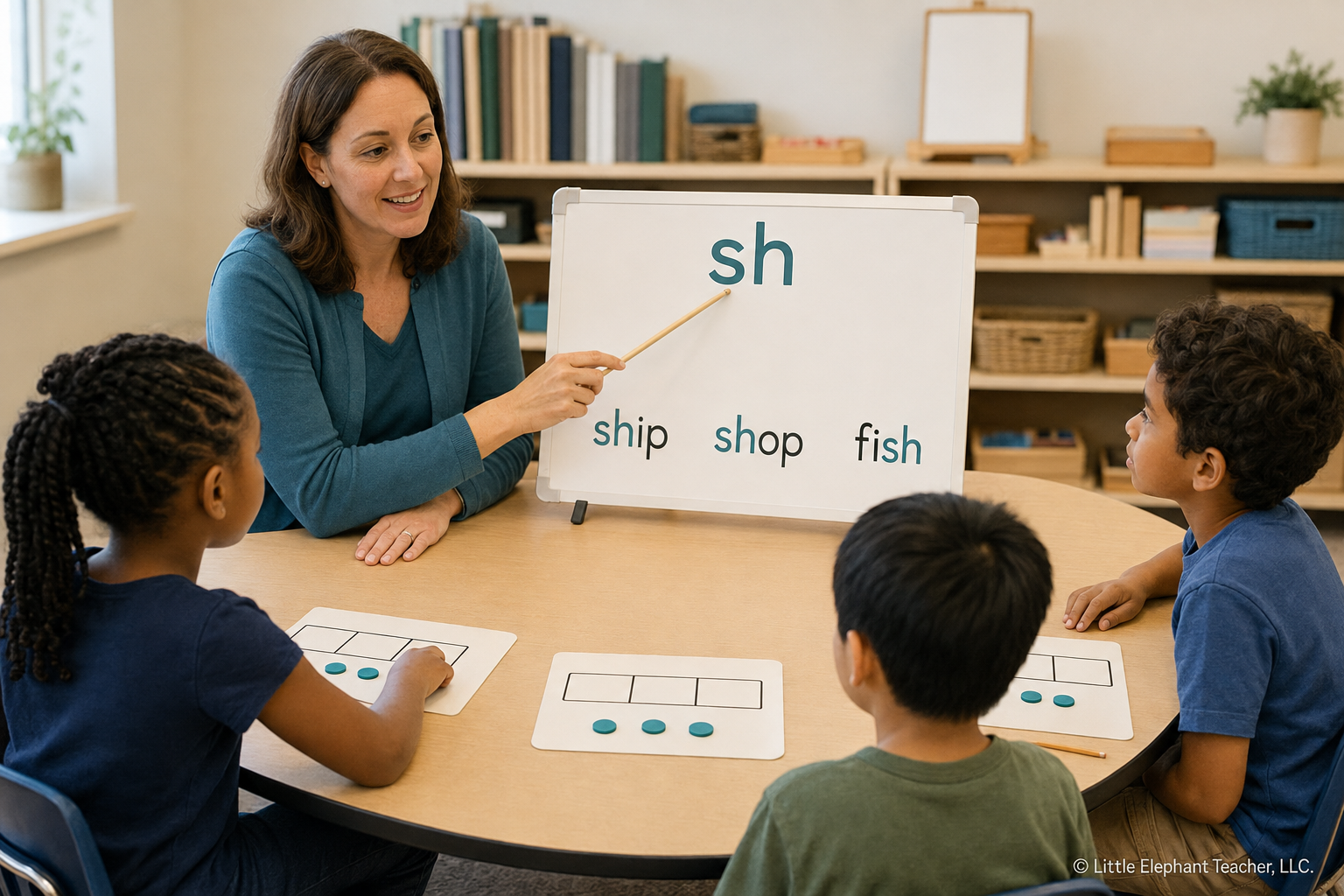
Perfectly matched groups are rare. The goal is to bring together students who can benefit from explicit instruction focused on the same phonics pattern.
Why Phonics Intervention Groups Must Remain Flexible
An intervention group is an instructional decision, not a permanent placement.
As students receive explicit instruction and practice, their needs change. Some skills become more accurate and automatic. Other difficulties become visible when students begin working with more complex words or connected text.
A group may need another look when:
Students are responding very differently to the same lesson
The group’s primary goal is becoming difficult to state
Some students consistently require different instruction
One student appears lost while another has already mastered the target
New assessment or progress-monitoring information raises questions
Flexibility does not mean moving students constantly or following a fixed calendar for regrouping. It means remaining responsive to the instruction students need now.
A clear phonics skill progression can help you understand why prerequisite knowledge matters and why students may not always be ready for the same instructional target.
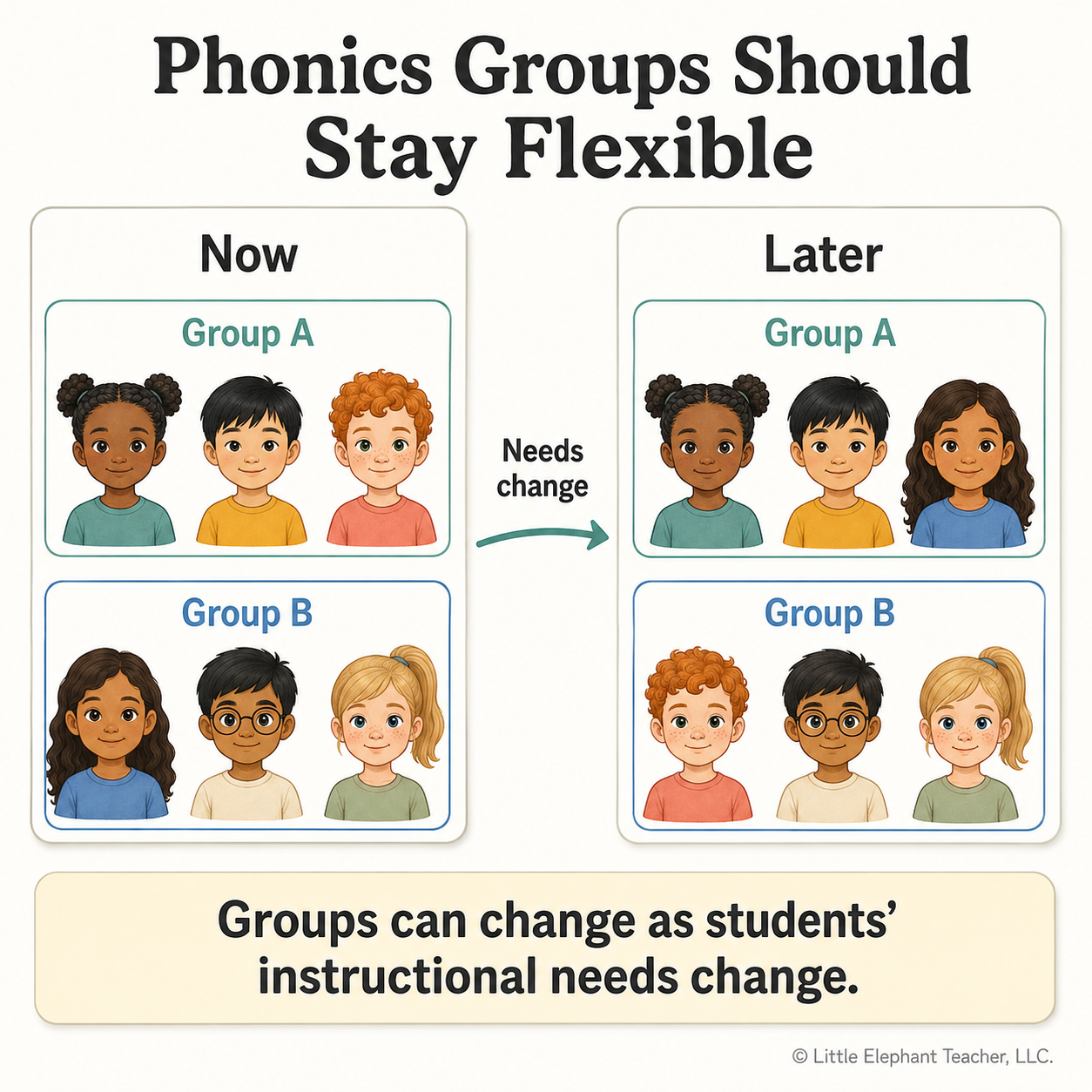
Phonics intervention groups are temporary instructional arrangements—not fixed labels. As students’ skill needs change, group membership can change too.
Common Reading Intervention Grouping Mistakes
Even thoughtful teachers can end up with poorly matched groups when the information available to them is too broad.
Grouping Students Only by Grade
Students in the same grade can have very different foundational phonics needs.
Grouping Only by Reading Level
A reading level describes general text performance. It does not identify the phonics pattern that should become the group’s instructional focus.
Sorting Students by One Total Score
Similar totals can represent different error patterns, levels of automaticity, spelling performance, and amounts of teacher support.
Placing Every Struggling Reader Together
A broad “low group” may include students with several unrelated needs. One lesson cannot target all of those needs explicitly at the same time.
Teaching Several Unrelated Skills in One Lesson
When a lesson moves rapidly among unrelated targets, students receive less focused modeling and practice with the skill they actually need.
Keeping Groups Fixed for Too Long
The purpose of intervention groups is targeted instruction—not permanent placement.
Starting Every Student at the Beginning
Automatically beginning with the earliest phonics skill can waste instructional time and overlook what a student already knows.
Moving Everyone Forward Together
Students do not always become ready for the next skill at the same time. Moving the entire group forward simply because a lesson sequence is finished can leave some students without the foundation they need.
Once You Know the Group’s Need, You Need Aligned Instruction
Identifying a shared instructional need is an important first step. The next challenge is finding instruction and practice that remain focused on that need.
Effective foundational-skills instruction should give students clear opportunities to connect sounds and letters, decode words, spell, build automaticity, and apply their learning in connected text. These priorities are also reflected in the What Works Clearinghouse foundational-skills practice guide.
When the lesson, decoding practice, spelling, phoneme-grapheme mapping, connected text, fluency work, and progress monitoring all reinforce the same skill, intervention becomes easier to plan—and more coherent for students.
Which Phonics Support Fits Your Classroom?
I Need a Complete Skill-by-Skill Phonics Intervention
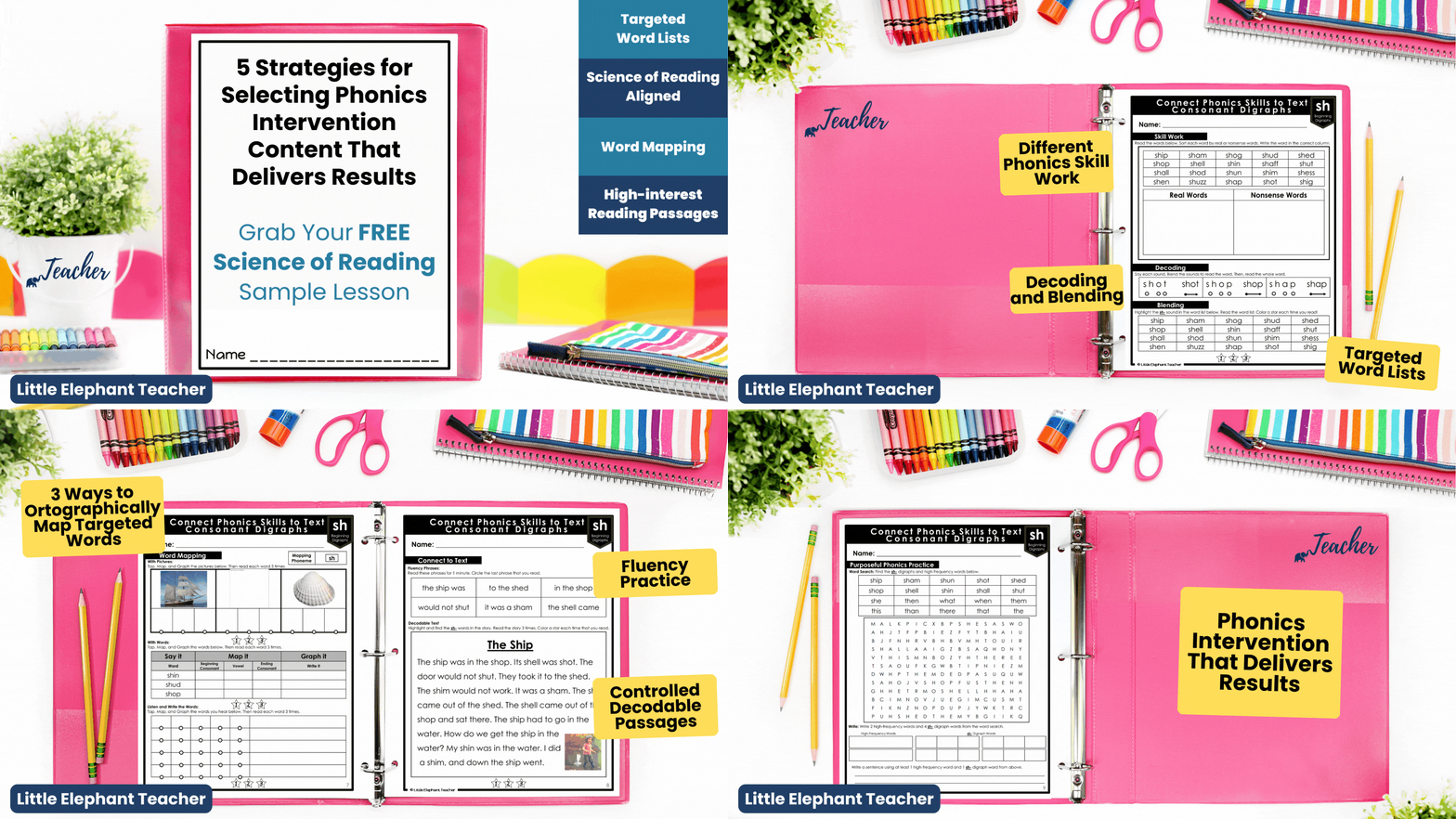
The Phonics Intervention Bundle provides explicit lessons organized by phonics pattern, including decoding and blending, spelling, phoneme-grapheme mapping, connected text, fluency, and purposeful student practice.
Once you know what your group needs, you can move directly into aligned instruction without searching for and piecing together every lesson component.
I Use UFLI Foundations
The UFLI-Aligned ENDLESS Bundle provides student practice aligned to the UFLI sequence, including decodable passages, comprehension questions, word mapping and phonics practice, irregular-word support, vocabulary resources, and progress monitoring.
It is designed for teachers who already know which UFLI lesson or skill their students need and want coordinated materials to support instruction and practice.

Still unsure what the assessment results mean?
Phonics Assessments That Drive Instruction™ teaches the complete process for selecting and administering assessments, interpreting error patterns, determining instructional starting points, forming targeted groups, choosing aligned instruction, and making progress-monitoring decisions.
Frequently Asked Questions About Phonics Intervention Groups
Should phonics groups be based on reading levels?
Not by reading level alone. Reading level provides broad information about text performance, but it does not identify the specific phonics pattern or foundational skill that should become the group’s instructional focus.
Can students from different grades be in the same phonics group?
Yes. Students from different grades may benefit from instruction together when they share a related foundational need and the materials remain age-respectful and instructionally appropriate.
Why might students with the same assessment score need different instruction?
Total scores can hide differences in error patterns, automaticity, spelling, prerequisite knowledge, connected-text application, and the amount of prompting each student requires.
How can I tell whether a phonics group is poorly matched?
A group may need another look when the primary goal is unclear, students require substantially different instruction, one student is consistently lost, or another student has already mastered the target.
How often should phonics groups change?
Phonics groups should remain flexible and respond to instructional evidence rather than follow a fixed calendar. The decision should be informed by the assessment and progress-monitoring procedures being used.
Focused Phonics Groups Make Strong Instruction More Effective
If a phonics group feels unusually difficult to teach, pause before assuming that you need a new lesson or a completely different intervention program.
Ask whether every student at the table actually needs the skill you are teaching.
Reading levels and total scores do not tell the entire story. Students do not have to look identical on paper, but they should share a related instructional need that allows everyone to benefit from the same lesson.
The goal is not to create perfect groups. It is to create focused, responsive groups—and then provide instruction and practice that remain aligned with that focus.
Effective phonics grouping is not about finding students who look the same on paper. It is about making sure the lesson is right for everyone sitting at the table.
About the Author
Andrea Russman is a Title I reading teacher and the curriculum developer behind Little Elephant Teacher®. She creates structured phonics intervention resources and uses assessment data to plan targeted small-group instruction for students who need additional foundational reading support.