What to Say When a Student Reads a Word Incorrectly: Corrective Feedback for Decoding Errors
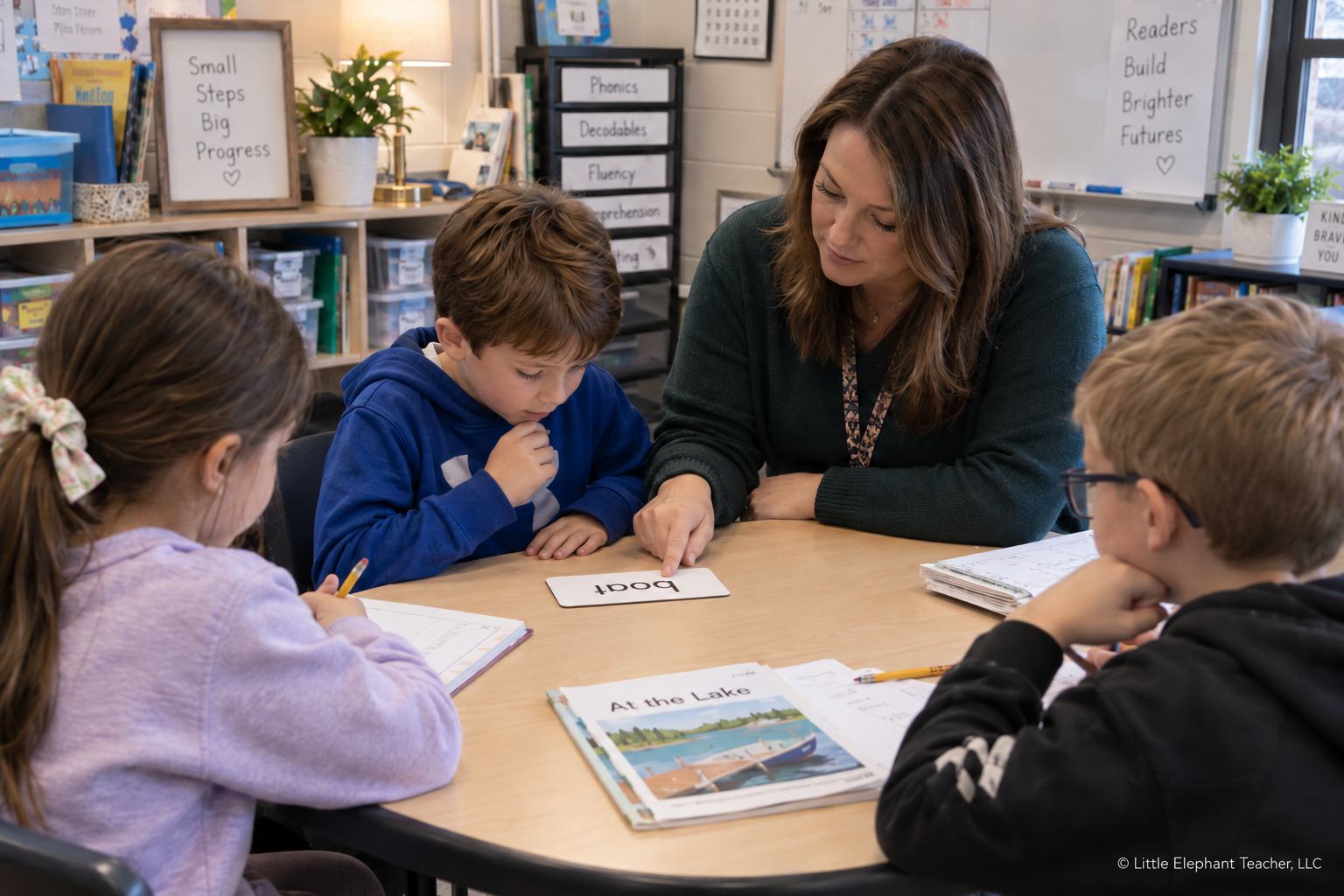
Corrective feedback should guide students back to the phonics information in the word while keeping them actively involved in decoding.
You are working with a small phonics group. You have already identified the skill students need and grouped them around a related phonics focus.
Then a student looks at the word boat and reads, “bot.”
You know the word is incorrect. But what should you say in those next few seconds? Do you tell the student the word? Say, “Try again”? Ask them to sound it out? Point to oa?
Once students are grouped around a related phonics need, the next challenge is knowing how to respond when they make errors during that targeted instruction.
Corrective feedback for decoding errors can feel like a small part of a phonics lesson, but these moments matter.
Correcting decoding errors is not just about supplying the right word—it is about helping the student return to the phonics information in the print.
The goal is to bring the student back to the word, connect the correction to phonics knowledge they have been taught, and give them another opportunity to do the decoding.
What Should You Say When a Student Reads a Word Incorrectly?
When a student misreads a word during phonics instruction, briefly direct attention to the relevant letters or spelling pattern. Give the student another chance to apply what they know.
If the student cannot retrieve the information they need, provide or model it. Then have the student read the word again and return to the sentence or text when appropriate.
The amount of support will vary. Think of this as a flexible progression rather than a script every student has to follow in exactly the same way.
Why Corrective Feedback Matters During Phonics Instruction
If a student reads map as “mop,” you could simply say:
“No, that word is map.”
The student hears the correct answer, but the teacher has completed most of the word-reading work.
A more instructional response might be:
“Look at the middle vowel.”
Now the student has another opportunity to use sound-spelling information that has already been taught.
The What Works Clearinghouse foundational-skills practice guide recommends explicit instruction that links sounds with letters and teaches students to decode words, analyze word parts, write words, and recognize words. It rates the evidence for sound-letter connections and decoding instruction as strong, and it also recommends connected-text reading to support accuracy, fluency, and comprehension.
A small comparative study of 35 children—14 with specific language impairment and 21 with typically developing language—also compared meaning-based feedback with graphophonemic word-decoding cues during oral reading. More miscued words were corrected overall in the graphophonemic-feedback condition. The study does not establish one correction routine as best for every student or situation, but it does support the value of directing students back to print during word-reading errors. You can read the study abstract on PubMed.
For classroom instruction, the takeaway is straightforward:
When the problem is decoding, bring the student's attention back to the printed word and the phonics information they should be using.
Practice With Targeted Phonics Words
Corrective feedback is easier to practice when your words are already organized around the phonics pattern you are teaching.
My free real and nonsense phonics word lists include targeted words you can use for decoding and blending practice during small-group instruction.
Why “Try Again” May Not Be Enough
Prompts such as “Try again,” “Look carefully,” and “Sound it out” are not automatically wrong. Sometimes a student needs only a brief reminder and will immediately self-correct.
The problem is that these prompts may be too broad when the student does not know what to reconsider.
If a student reads hope as “hop,” compare:
“Try again.”
with:
“Look at the e at the end. Now look back at the vowel.”
The second prompt gives the student a clearer place to direct attention.
“Sound it out” can also be useful. But if the student has already attempted the word and does not know which sound-spelling information needs reconsideration, a more specific cue may help.
Meaning and pictures have important roles in understanding text, too. But during a phonics-specific decoding error, they should not replace attention to the printed word. A word can make sense in the sentence and still be read incorrectly.
This is also where overprompting during phonics instruction can quietly creep in. The aim is not to keep adding hints. Give the most useful support, then return the word to the student.
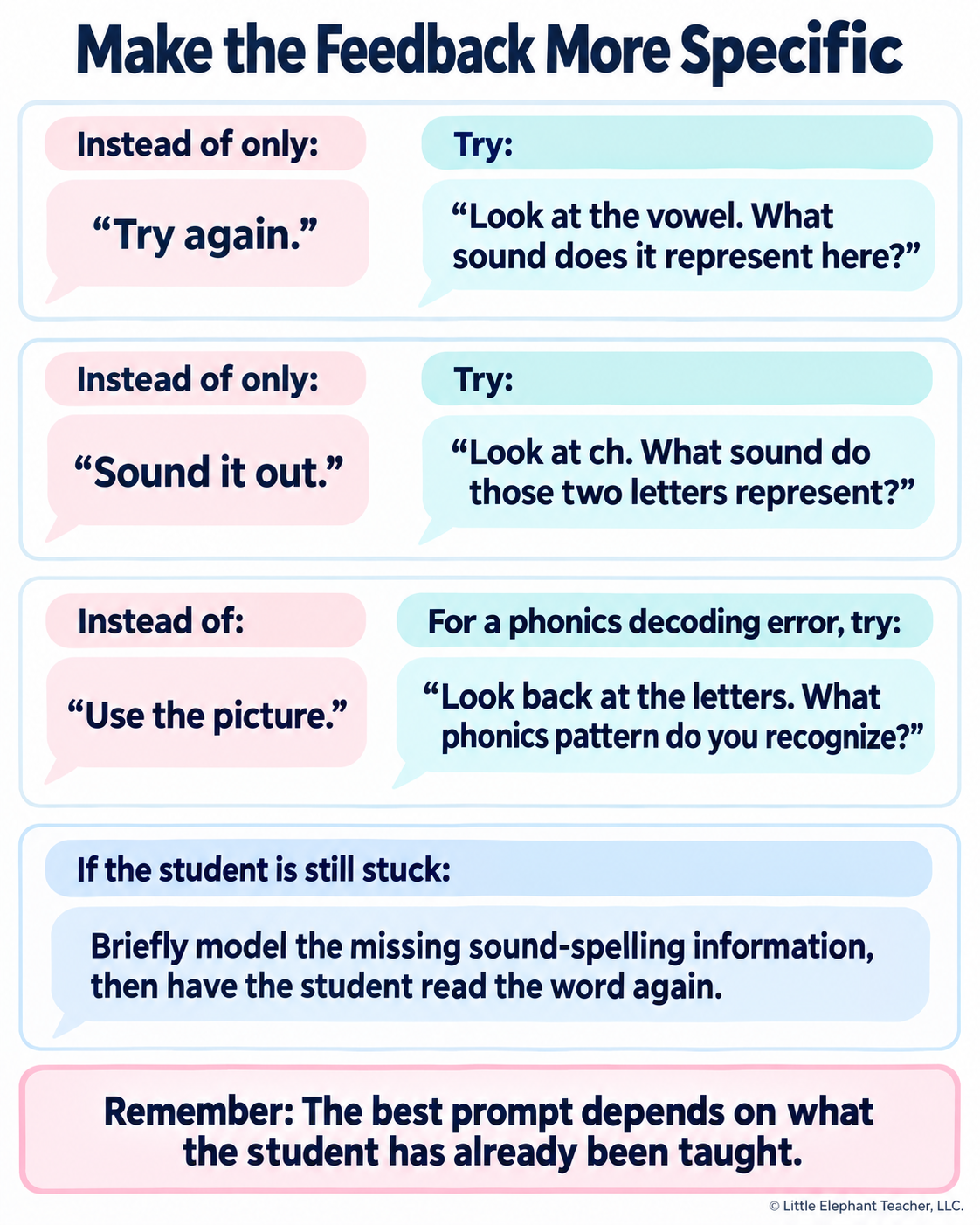
A more specific prompt can help a student know which part of the printed word to reconsider.
A Flexible Corrective-Feedback Routine for Decoding Errors
You do not need a long script every time a student misreads a word. Use only as much support as the student needs.
1. Redirect Attention to the Print
Bring the student's attention back to the relevant part of the word.
You might say:
“Look at the vowel.”
“Check the beginning.”
“Look at these two letters.”
Be specific enough to focus attention without immediately supplying the answer.
2. Cue Previously Taught Sound-Spelling Information
Ask the student to use phonics knowledge they have already learned.
For example:
“What sound does ch represent?”
or:
“What sound does oa represent in this word?”
Corrective feedback should direct students toward phonics knowledge they have already been taught—not require them to independently retrieve an unfamiliar spelling pattern.
A clear phonics skill progression helps make sure students are being asked to apply patterns they have actually learned.
3. Give the Student Another Opportunity
After the cue, stop talking long enough for the student to do the reading.
You might simply say:
“Now blend it again.”
or:
“Read the whole word.”
4. Increase the Support When Needed
If the student cannot retrieve the needed information, provide it.
For example:
“Ch represents /ch/. Say /ch/. Now read the word.”
At that point, brief explicit modeling is more useful than continuing to ask questions the student cannot yet answer.
5. Reread and Return to the Text
Once the student reads the word correctly, have them say the whole word again.
If the word came from a sentence or passage, return to the text and reread the sentence.
Sometimes the first cue will be enough. Other times, the student will need a brief model. The purpose of this framework is to help you adjust the amount of support while keeping the student involved in the decoding.
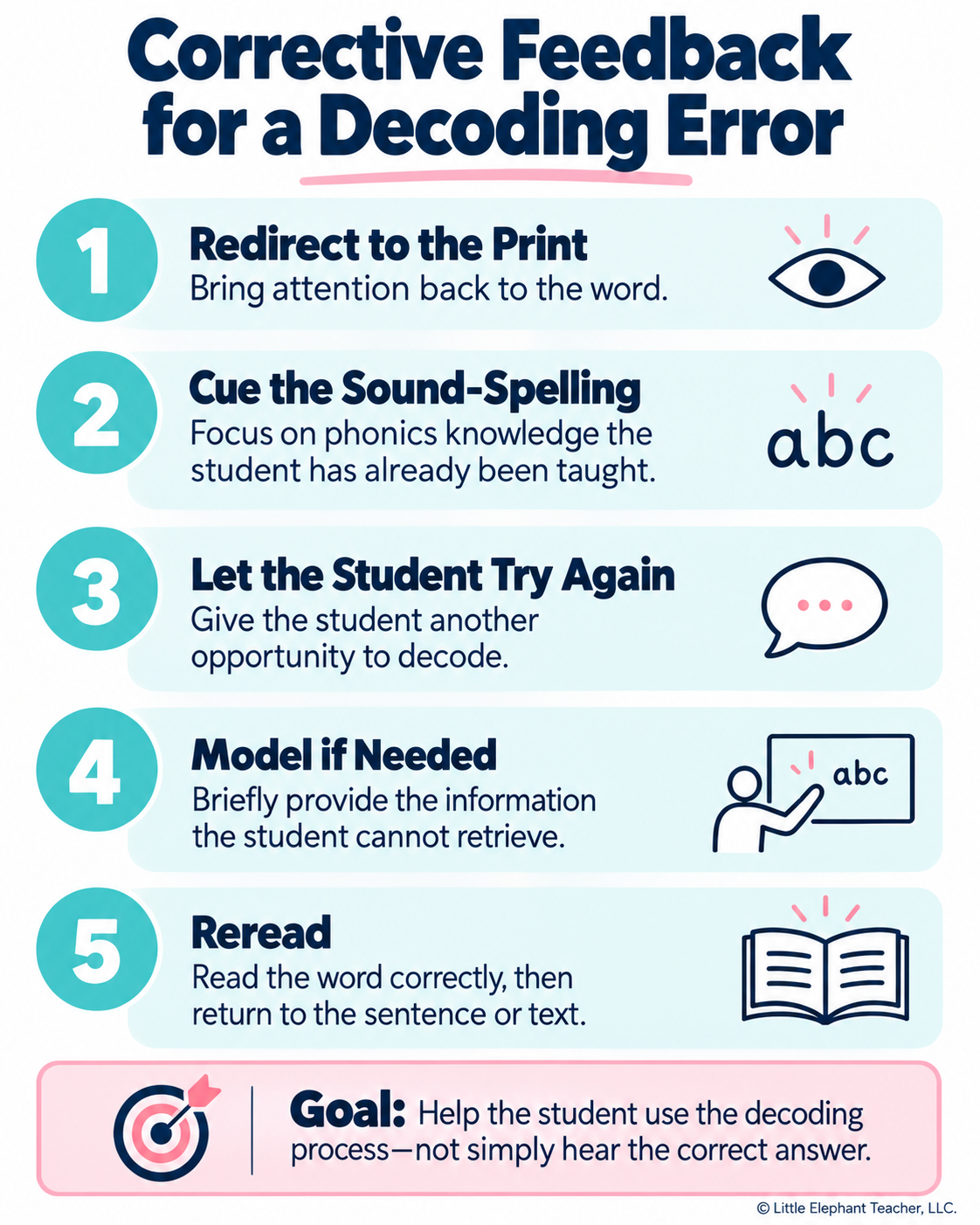
Use only as much support as the student needs, then return the decoding work to the student.
What Corrective Feedback Can Sound Like
These examples assume the phonics pattern has already been taught. They show how feedback can become more explicit without turning one mistake into a diagnosis.
CVC Word: map → “mop”
Teacher: “Look at the middle vowel. What sound does a represent here?”
Then:
“Now blend the whole word again.”
If more support is needed:
“This is a. It represents /ă/. Say /ă/. Now blend /m/ /ă/ /p/.”
Digraph: chop → “cop”
Teacher: “Look at the first two letters. What sound does ch represent?”
Then:
“Start again and blend the whole word.”
If needed:
“Ch represents /ch/. Say /ch/. Now read the word.”
Consonant Blend: stop → “sop”
Teacher: “Look at the beginning again. Say both consonant sounds.”
Then:
“Keep both sounds as you blend through the word.”
If needed, briefly model /s/ /t/ /ŏ/ /p/, then ask the student to blend the word.
Silent-e: hope → “hop”
Teacher: “Look at the final e. This word has an o-consonant-e pattern. What sound does o represent?”
If needed:
“In hope, o represents /ō/. Now read the whole word.”
Vowel Team: boat → “bot”
Teacher: “Look at oa. What sound does oa represent in this word?”
If needed:
“In boat, oa represents /ō/. Now blend the whole word.”
If the word came from connected text, finish with:
“Now go back and read the sentence again.”
Notice how brief these exchanges can be. Corrective feedback does not need to become another lesson inside the lesson. Give enough information to move the student toward accurate decoding, then let the student do the reading.

After correcting the word, return the reading work to the student and have them reread the word in context.
When a Prompt Is Not Enough: Model, Then Give the Word Back
Sometimes a student simply cannot retrieve the information you are asking for.
If you point to ch and ask for the sound and the student does not know it, another vague prompt is unlikely to help.
Briefly provide the information:
“Ch represents /ch/. Say /ch/. Now read the word.”
There is no need for a fixed rule such as “always prompt twice.” Provide the support the student needs, then return the reading task to the student.
What If the Same Decoding Error Keeps Happening?
One misread word and a recurring difficulty are not the same thing.
If a student repeatedly struggles with a phonics pattern that has already been taught—even with explicit support and additional practice—that pattern is worth noticing.
You might broadly consider whether the difficulty is recurring, whether accuracy is improving with practice, and whether the student can apply the target in both reading and spelling.
Those observations do not automatically tell you where instruction should begin.
If the pattern continues, you can look more closely at repeated phonics errors and what those decoding attempts may reveal.
One Corrected Word Is Not Enough
Return to boat.
The student first says “bot,” receives a cue, and then correctly reads boat.
That is a successful correction—but one correct rereading does not establish that the vowel-team skill is secure.
Students need additional opportunities to use the same target through:
decoding and blending;
spelling or encoding;
phoneme-grapheme mapping;
connected text; and
rereading for accuracy and fluency.
If you need additional ideas for word-level practice, these phonics word-list decoding activities give students more opportunities to apply a targeted pattern.
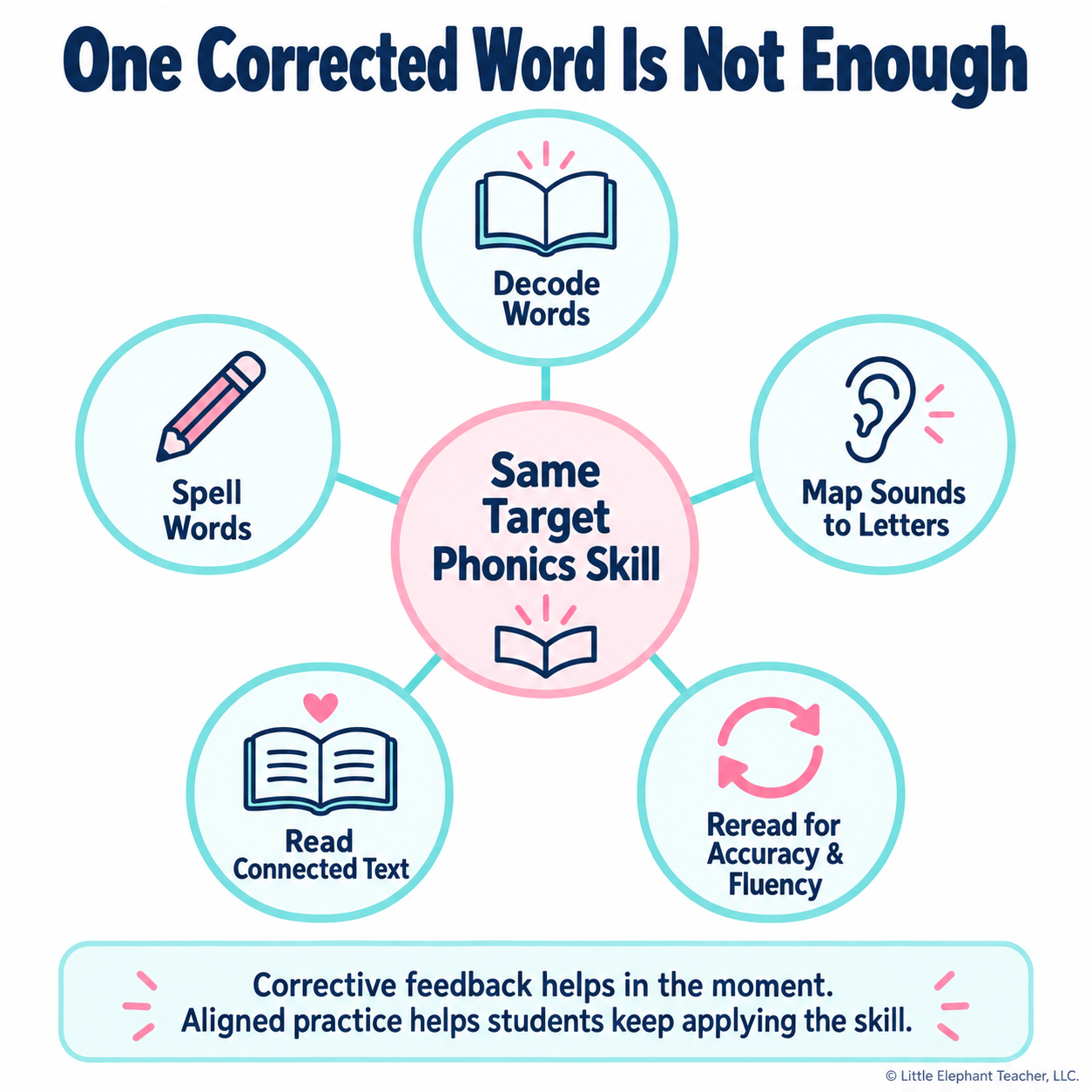
Correcting one word supports the immediate reading attempt. Students still need multiple ways to apply the same phonics skill.
Correcting the error helps in that moment. Building the skill requires aligned practice.
Once you know the skill students need, you should not have to search separately for every part of the intervention.
The Phonics Intervention Bundle keeps explicit instruction and practice centered on the same phonics target, with decoding and blending, phoneme-grapheme mapping, connected text, fluency, and purposeful student practice.
Choose the Phonics Support That Fits Your Classroom
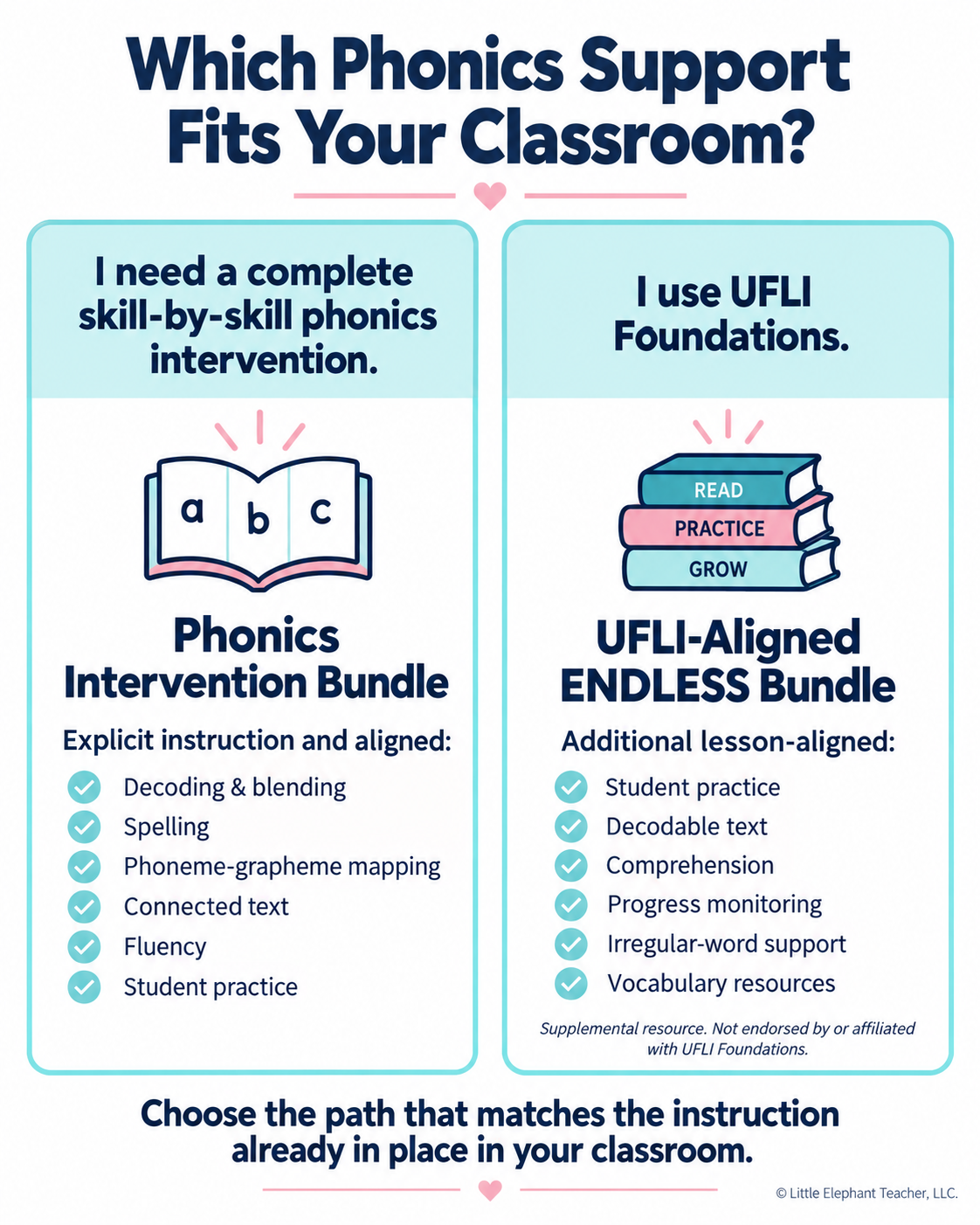
Choose the implementation path that matches the phonics instruction already in place in your classroom.
I Need a Complete Skill-by-Skill Phonics Intervention
Choose the Phonics Intervention Bundle when you need intervention organized by phonics skill, with explicit instruction and practice that stay focused on the same target.
I Use UFLI Foundations
If you already use UFLI Foundations, you have an instructional sequence in place. UFLI's official description includes grapheme-phoneme correspondence, decoding and encoding practice, irregular-word instruction, and connected text.
The UFLI-Aligned ENDLESS Bundle provides additional lesson-aligned student practice, including workbook activities, decodable passages with comprehension questions, progress-monitoring tools, irregular-word support, and other resources aligned with the UFLI sequence.
Little Elephant Teacher® UFLI-aligned resources are supplemental and are not endorsed by or affiliated with UFLI Foundations.
Correct the Process, Not Just the Word
The next time a student misreads a word, you do not need a complicated script.
Bring attention back to the print. Point the student toward phonics knowledge that has already been taught. Give another chance to apply it. Provide the missing information when needed, then let the student read the word again.
The goal is not only to correct the word in front of the student.
It is to strengthen the decoding process they can use with the next word.
Frequently Asked Questions About Corrective Feedback for Decoding Errors
What should I say when a student reads a word incorrectly?
Direct attention to the relevant letters or spelling pattern, cue previously taught phonics information, and give the student another opportunity to read the word. If needed, provide the missing information and have the student try again.
Should I tell a student the word when they cannot decode it?
Sometimes more explicit support is appropriate. Do not keep prompting indefinitely when the student does not have the information needed to respond. Briefly model or provide what is missing, then return the reading task to the student.
Is “sound it out” a good prompt for a decoding error?
It can be. If the student has already attempted the word and does not know what to reconsider, a more specific cue may be more useful.
Should students use pictures or context to figure out an unfamiliar word?
Pictures and context can support comprehension, but they should not replace attention to the printed word during a phonics-specific decoding task.
What should I do if a student keeps making the same decoding error?
Repeated difficulty is worth noticing. The student may need additional explicit instruction and practice, and a recurring pattern may deserve closer analysis. Avoid making a complete instructional-placement decision from one error alone.

Research Referenced in This Article
For additional information about foundational reading instruction and corrective feedback, see the What Works Clearinghouse foundational-skills practice guide and Kouri, Selle, and Riley's comparative study of meaning-based and graphophonemic feedback.
About the Author
Andrea Russman is a Title I reading intervention teacher and curriculum designer. She creates practical, systematic phonics resources to help elementary teachers provide targeted instruction for developing and struggling readers.