Why Can My Student Read Word Lists but Struggle With Decodable Text?
Have you ever had a student read a word list like this?
ship
shop
fish
rush
They read every word correctly. You feel like the phonics skill is finally starting to stick.
Then you open a decodable passage and the student gets to:
The fish is on the ship.
They stop.
Maybe they look at you and wait. Maybe they guess. Maybe you find yourself saying, “What do those two letters say together?”
And you are thinking, You just read fish and ship two minutes ago. Why does it seem like the skill disappeared?
I see this often with students receiving reading intervention. One of the most important things to remember is that knowing a phonics skill and automatically applying it while reading are not the same stage of learning.
A student may successfully use a phonics pattern when the skill has just been taught, the teacher has told them what to look for, and several words in a row contain the same pattern.
Connected reading changes the conditions.
Now the student has to recognize and retrieve that phonics knowledge while moving through a sentence, noticing other patterns, blending unfamiliar words, and keeping track of meaning.
A student can read a phonics pattern correctly in a word list and still need more practice applying that same pattern independently in connected text.
If you have a student who can read words but not sentences with the same independence, the issue may be less about whether the phonics skill was taught and more about how consistently the student can retrieve and apply it during connected reading.
That does not mean word-list practice is ineffective. It means word-level practice is one part of the learning process.
For many intervention students, we have to intentionally build the bridge from accurate word-level decoding to independent application during connected reading.

Students may read a phonics pattern accurately in a word list before they can apply that same pattern independently in connected text.
Why Are Word Lists Often Easier Than Connected Text?
Word lists are an important part of phonics instruction. I use them because they give students a focused opportunity to practice exactly what I am teaching.
But reading a controlled word list and reading connected text place different demands on the student.
Word Lists Narrow the Student's Attention
Imagine that you have just taught the vowel team oa.
You tell your students, “We are going to practice words with oa.”
Then they read:
boat
coat
road
goat
The student is still doing the decoding, but the task provides helpful clues.
They know which phonics pattern to expect. The same pattern appears repeatedly. Their attention is focused on one word at a time. They do not have to hold the meaning of a sentence in mind. You may have even reviewed the sound for oa immediately before they begin reading.
That kind of focused practice is useful. Students need opportunities to apply a newly taught phonics pattern in individual words.
The problem comes when successful word-list reading is treated as the end point rather than one step toward independent reading.
Connected Text Requires More Independent Retrieval
Now place that same phonics pattern into a sentence:
The goat ran down the road.
The student is no longer being told, “Every word you are about to read has oa.”
They have to move across different words, recognize familiar words, distinguish among phonics patterns, blend unfamiliar words, and keep enough of the sentence in mind to understand what they are reading.
The phonics pattern has not changed. The conditions under which the student has to retrieve and use it have.
Students need opportunities to decode words both in isolation and in connected text. The What Works Clearinghouse recommends having students read decodable words in both settings and providing regular connected-text reading to support accuracy, fluency, and comprehension.
Read the What Works Clearinghouse foundational-skills practice guide.
This also makes text selection important. During phonics practice, connected text should give students a reasonable opportunity to use patterns they have actually been taught.
Difficulty in connected text does not automatically mean we should abandon the text and return only to word lists.
It may tell us that the student needs more support bridging the skill from controlled practice into actual reading.
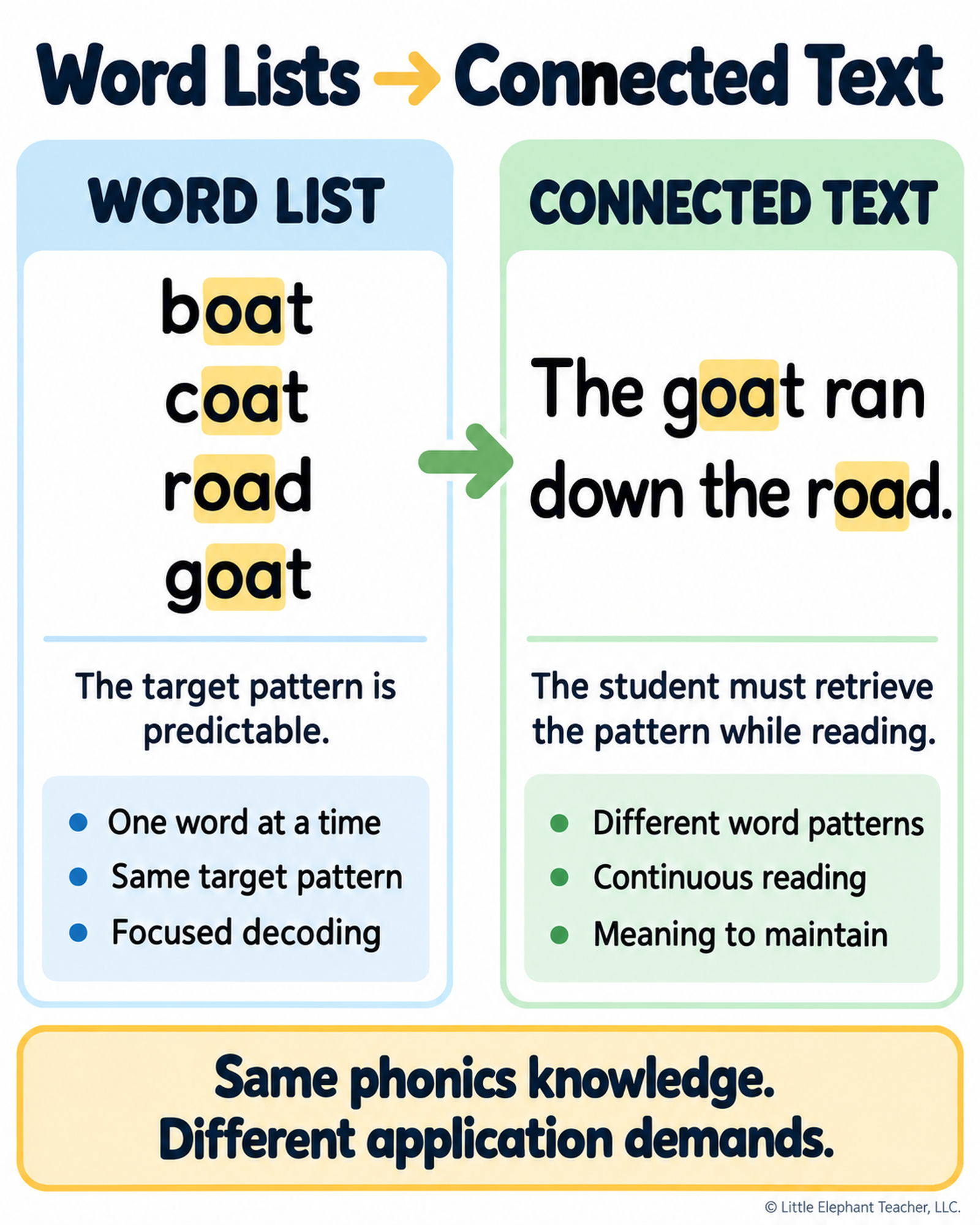
The phonics pattern stays the same, but connected text requires students to retrieve and apply it among other words and reading demands.
Knowing a Phonics Skill Is Not the Same as Automatically Applying It
It can be tempting to think of phonics skills as either mastered or not mastered.
With intervention students, I find it more useful to pay attention to how independently and efficiently the student can apply the skill.
There is an important difference between using a pattern immediately after instruction and recognizing that same pattern independently during reading.
The Student Can Use the Skill With the Target Clearly Identified
Imagine that you have just taught sh.
The student reads:
ship
shop
shut
fish
accurately.
That is useful information. The student has demonstrated that they can apply sh under those controlled conditions.
But I would be careful about immediately saying, “Great! sh is mastered.”
The next question is whether the student can recognize and apply that same knowledge when the target is no longer identified for them.
The Student Can Apply the Skill With a Prompt
Later, the student encounters:
The ship is big.
They stop at ship.
You say:
“Look at the first two letters.”
The student responds:
“/sh/ … ship.”
The student was able to access the phonics knowledge, but your prompt helped initiate the process.
That is different from independent application.
It is also still progress.
The Student Applies the Skill Independently
The next time the student encounters ship, they pause briefly, notice sh, blend the word, and continue reading.
You did not have to identify the pattern or tell them which sound to use.
They did the word-solving themselves.
It might still be slow, and that is okay.
Independence can develop before automaticity.
A student who takes a few seconds to decode accurately on their own is showing something different from a student who cannot apply the pattern without teacher support.
The Skill Becomes Increasingly Automatic
With continued successful practice and reading experience, familiar sound-spelling relationships and words can begin to require less effort.
That does not mean our goal is to stop students from sounding out unfamiliar words.
Students will still need to decode words they do not immediately recognize.
Our goal is for accurate decoding of increasingly familiar patterns and words to become more efficient so the student can devote more attention to the sentence and its meaning.
Research on orthographic mapping helps explain why accurate connections between letters and sounds matter for building word memory. Linnea Ehri describes orthographic mapping as the process of forming letter-sound connections that bond a word's spelling, pronunciation, and meaning in memory.
That does not mean orthographic mapping is a separate classroom activity or that a fixed number of repetitions automatically “maps” a word.
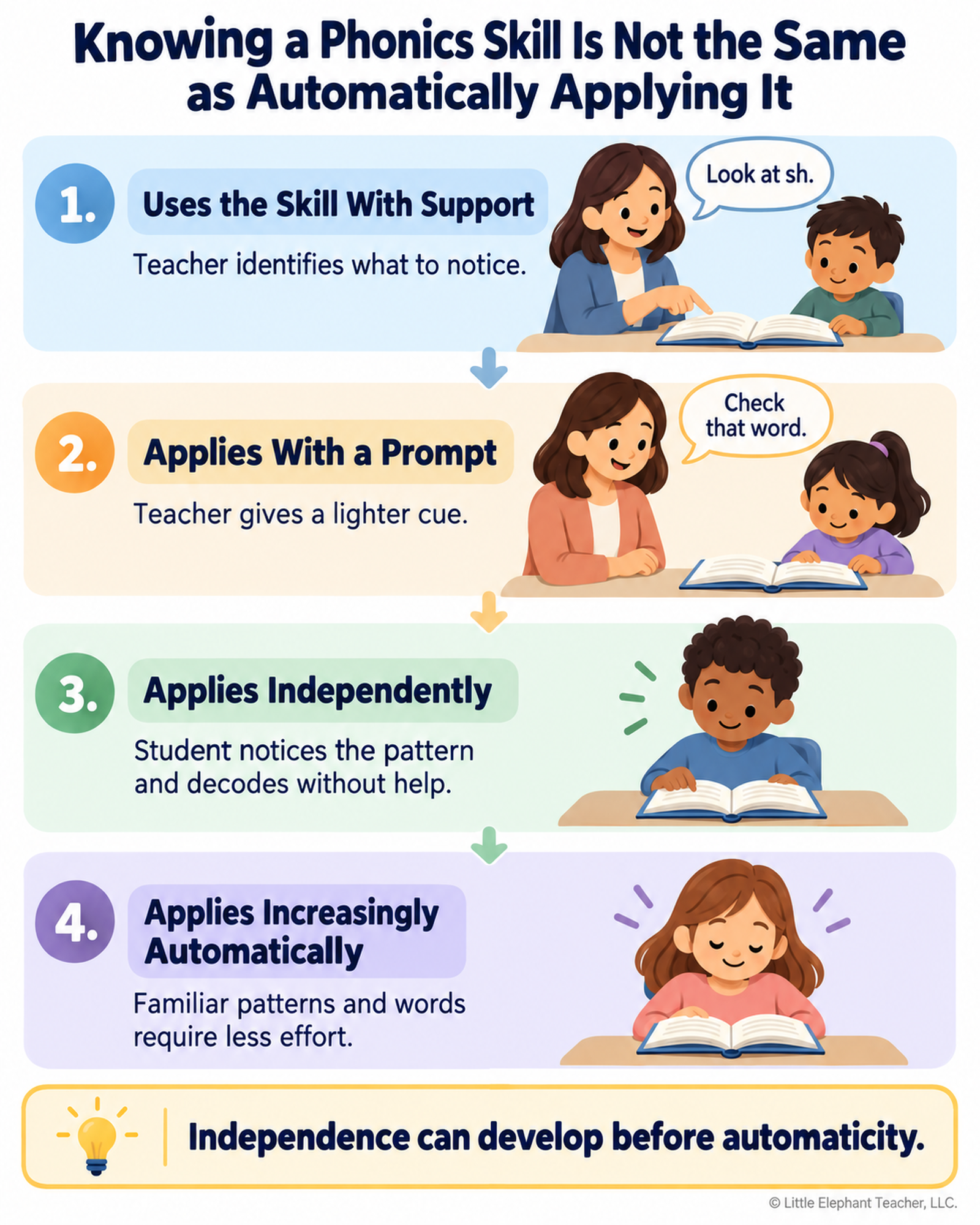
A phonics skill can move from supported use to independent and increasingly automatic application over time.
Once we think about phonics learning as a progression rather than a simple “knows it/doesn't know it” decision, the behaviors we hear during reading become much more informative.
What Should I Notice When a Student Reads the Words but Struggles With the Passage?
Instead of looking only at whether the student finished the passage correctly, pay attention to what happens while the student is reading.
Those behaviors can give you useful information about what the student may need next.
The Student Hesitates on Patterns That Were Easy in the Word List
Maybe the student quickly read boat during word practice but hesitates when boat appears in a sentence.
That does not necessarily mean the student suddenly forgot oa.
The phonics knowledge may still be available, but retrieving it is slower when the pattern appears among many other words and patterns.
One hesitation is not enough information to decide that the entire skill needs to be retaught.
I want to watch what happens across several opportunities.
The Student Looks at You Before Trying
This is something I pay close attention to in intervention groups.
A student reaches a difficult word and immediately looks at me.
I prompt.
They read it.
Then they reach another difficult word and look at me again.
If a student repeatedly waits for a cue before attempting the word, I start watching whether my prompting has become part of the student's reading routine.
The student may be able to do more than they are currently initiating on their own.
That means I need to think not only about whether my prompt works, but also about how I will gradually reduce that support.
The Student Goes Back to Guessing
Sometimes a student who can decode during word practice begins guessing once they reach connected text.
Instead of attending closely to the letters, they say a word that fits the picture, the first letter, or what they think would make sense in the sentence.
When word reading becomes more demanding, some students may fall back on less reliable habits.
That is a signal for me to redirect the student back to the print and the phonics knowledge they have been taught.
The Student Sounds Out Almost Every Word
This one needs some nuance.
Sounding out words is not a bad thing.
Beginning readers and struggling readers often need to decode unfamiliar words carefully. We do not want students guessing simply because sounding out takes time.
The question I am asking is:
Are previously taught patterns becoming easier for the student to retrieve over time?
A student who independently sounds out an unfamiliar word is using a valuable strategy.
But if the same familiar patterns continue to require the same amount of effort and prompting, I want to look more closely at the practice and support the student is receiving.
The goal is not to stop students from sounding out words. The goal is to help accurate decoding become increasingly efficient.
The Student Is Accurate but Very Slow
Accuracy and efficiency are related, but they are not the same thing.
A student who independently reads a word correctly after working through it slowly is showing something different from a student who cannot access the phonics pattern without teacher help.
I do not want to overlook that progress simply because the reading is not fluent yet.
And I do not want fluency practice to become “read this as fast as possible.”
I am looking for accurate reading that gradually requires less effort and less support.
This is also why I look beyond a broad reading level when making intervention decisions. I explain that more fully in:
How to Group Students for Phonics Intervention: Why Skill Needs Matter More Than Reading Levels
One difficult passage does not tell you exactly why a student is struggling.
The phonics skill may still be unstable. The text may contain too many untaught patterns. Blending may still be effortful. Word recognition may be slow. The student may need additional cumulative practice. More than one factor may also be involved.
So instead of asking only:
“Does this student know the skill?”
I find it more useful to ask:
“What kind of practice will help this student use the skill more independently?”
How Do I Help Phonics Skills Transfer Into Connected Reading?
When a student is stronger with isolated words than connected text, I do not want to skip the word-level practice they still need.
But I also do not want to leave them there.
The goal is to deliberately connect the two.
1. Make Sure the Student Can Actually Decode the Pattern
Before I call something a transfer problem, I want enough information to know that the student can use the phonics pattern at the word level.
If we are working on oa, I might listen to the student read several words such as:
boat
road
foam
coat
I do not want to check only one word the student has already practiced repeatedly. I want to hear whether they can apply the phonics knowledge across several examples.
If the student still cannot reliably decode the pattern in isolated words, connected text is not the only issue. The underlying phonics skill may still need additional explicit instruction and word-level practice.
For this article, I am not talking about making a full placement or diagnostic decision.
I simply want enough information to distinguish between:
“This skill is still unstable at the word level.”
and
“This student is more accurate at the word level but is not yet applying the skill consistently during connected reading.”
If you want a quick way to listen to how students apply phonics patterns to both real and unfamiliar words, my free real and nonsense phonics word lists can be helpful here.
Get the Free Real and Nonsense Phonics Word Lists
2. Give Students Repeated Opportunities to Decode the Pattern
One correct response is useful information, but students often need more than one successful encounter before a pattern begins showing up consistently in different reading situations.
For oa, that might include:
boat
road
toast
foam
Notice that I am not simply having the student read boat over and over.
I want the pattern to appear in different words so the student has to apply the phonics knowledge rather than memorize one tiny set.
The beginning sound can change. The ending can change. As students are ready, the word structure can become more varied.
Repeated successful decoding gives students additional opportunities to retrieve and apply the phonics knowledge they are learning.
There is no magic number of repetitions that guarantees automaticity. Some students will need considerably more practice than others.
The important part is that the student continues to do the decoding work across multiple successful encounters.
3. Make Practice Cumulative
After focused practice with a new pattern, I also want students to retrieve that pattern among skills they have already learned.
Compare these two lists:
boat
coat
road
goat
and
fish
boat
rain
coat
shop
road
The first list has a clear purpose: concentrated practice with oa.
The second list asks something different.
Now the student cannot assume that every word contains oa. They have to look closely and decide which phonics knowledge applies.
Instead of thinking:
“Every word has oa.”
the student has to think:
“What do I know about this word?”
Cumulative practice begins to remove some of the clues that tightly controlled word lists give students.
That makes the student retrieve phonics knowledge more flexibly and begins moving the task closer to what happens during connected reading.
Systematic, cumulative instruction deliberately builds new learning on concepts students have already learned. The International Dyslexia Association describes cumulative instruction as instruction in which one concept builds on another rather than previously taught knowledge simply disappearing when a new skill is introduced.
Learn more about Structured Literacy from the International Dyslexia Association.
This is one reason a systematic, cumulative phonics sequence matters.
Read: What Order Should Phonics Skills Be Taught? A Practical Guide
4. Move the Pattern Into Aligned Connected Text
This is the bridge that can easily be missed.
A student can complete phonics drills, read word cards, and practice spelling, but they also need opportunities to use those skills while actually reading.
Students need opportunities to apply phonics skills in connected text, not only demonstrate those skills during isolated word practice.
That might look like moving from:
Word: ship
to:
Phrase: the big ship
to:
Sentence: The big ship is at the dock.
and then into a short decodable passage containing appropriate sh words along with patterns the student has already learned.
I am not saying every student needs to move through those exact four steps every time a skill is taught.
The progression simply illustrates how the application demands increase.
At the word level, the student can focus almost entirely on decoding one word.
In connected text, the student has to retrieve phonics knowledge while moving through multiple words and maintaining meaning.
Decodable text can be especially useful here because it gives beginning and struggling readers opportunities to apply sound-spelling relationships they have already been taught.
Reading Rockets similarly recommends carefully choosing decodable texts whose phonics features align with what students have learned or are currently learning.
Read more about using decodable books from Reading Rockets.
Connected text should give students a chance to apply what they have been taught—not force them to guess through a large number of patterns they have never learned.
This is one reason I want the connected text I use during intervention to match the phonics sequence I am teaching.
If my goal is to see whether a student can apply oa, I do not want the rest of the passage filled with spelling patterns the student has not learned yet.
When the text is aligned, I can pay closer attention to whether the student is beginning to use the phonics knowledge we have actually practiced.
5. Redirect Students to Print When They Get Stuck
Once students begin applying the skill in connected text, mistakes are going to happen.
That is not a reason to stop.
It is an opportunity to help the student reconnect with what they have already learned.
For example, if a student misreads boat, I might say:
“Look at oa.”
The student gives the sound.
Then I say:
“Now read the whole word.”
After the student reads boat, we return to the sentence.
I want my support to point the student back to the print without doing all of the word-solving for them.
That does not mean I use exactly the same prompt after every error. The amount of support depends on what the student is doing and what they already know.
I walk through this much more deeply in:
What to Say When a Student Reads a Word Incorrectly: Corrective Feedback for Decoding Errors
The important connection here is that corrective feedback should ultimately return the student to reading.
We are not correcting a word in isolation and then forgetting the sentence around it.
6. Reread After Successful Decoding
Sometimes the first reading sounds like this:
“The…g…oa…t…goat…ran down the road.”
The student may have read the sentence accurately, but a great deal of attention went into solving the words.
Once the student has worked through it successfully, I might say:
“Great. Go back and read the whole sentence again.”
That gives the student another opportunity to encounter those successfully decoded words within the full sentence.
Purposeful rereading can be one part of connected-text fluency practice. The Florida Center for Reading Research includes rereading decodable text as an activity designed to build greater speed and accuracy in connected-text reading.
See the Florida Center for Reading Research rereading activity.
I would be careful, though, about turning this into:
“Read it again until you are fast.”
Speed alone is not the goal.
I want reading to become increasingly accurate, efficient, and independent while the student continues to attend to meaning.
7. Gradually Reduce Your Prompts
This is one of the biggest things I watch during intervention.
At first, a student may need:
“Look at the vowel team.”
Later, I may simply say:
“Check that word.”
Eventually, I may pause and wait.
The student notices the problem and tries again without me identifying what to look at.
That reduction in support matters.
The goal of prompting is not to create a routine where the student waits for us before doing anything difficult.
The goal is to help the student eventually initiate that same thinking independently.
If I am giving the same cue before every difficult word, I start asking myself whether I am doing part of the retrieval work for the student.
Sometimes the next step is not a stronger prompt.
It is giving the student an extra moment to try.
8. Watch for the Skill to Show Up Without You
Ultimately, I want to see the phonics skill begin to appear when I am not telling the student to use it.
I look for changes such as:
less hesitation on previously taught patterns,
fewer teacher prompts,
more self-correction,
accurate decoding of unfamiliar words containing the pattern,
smoother rereading,
successful application in new sentences or passages,
and previously taught skills continuing to show up during cumulative practice.
I am not looking for one magic percentage that proves a skill has transferred.
I am looking for a pattern of less support from me and more successful application from the student.
That gives me much more useful information than simply asking whether the student got every word on one list correct.
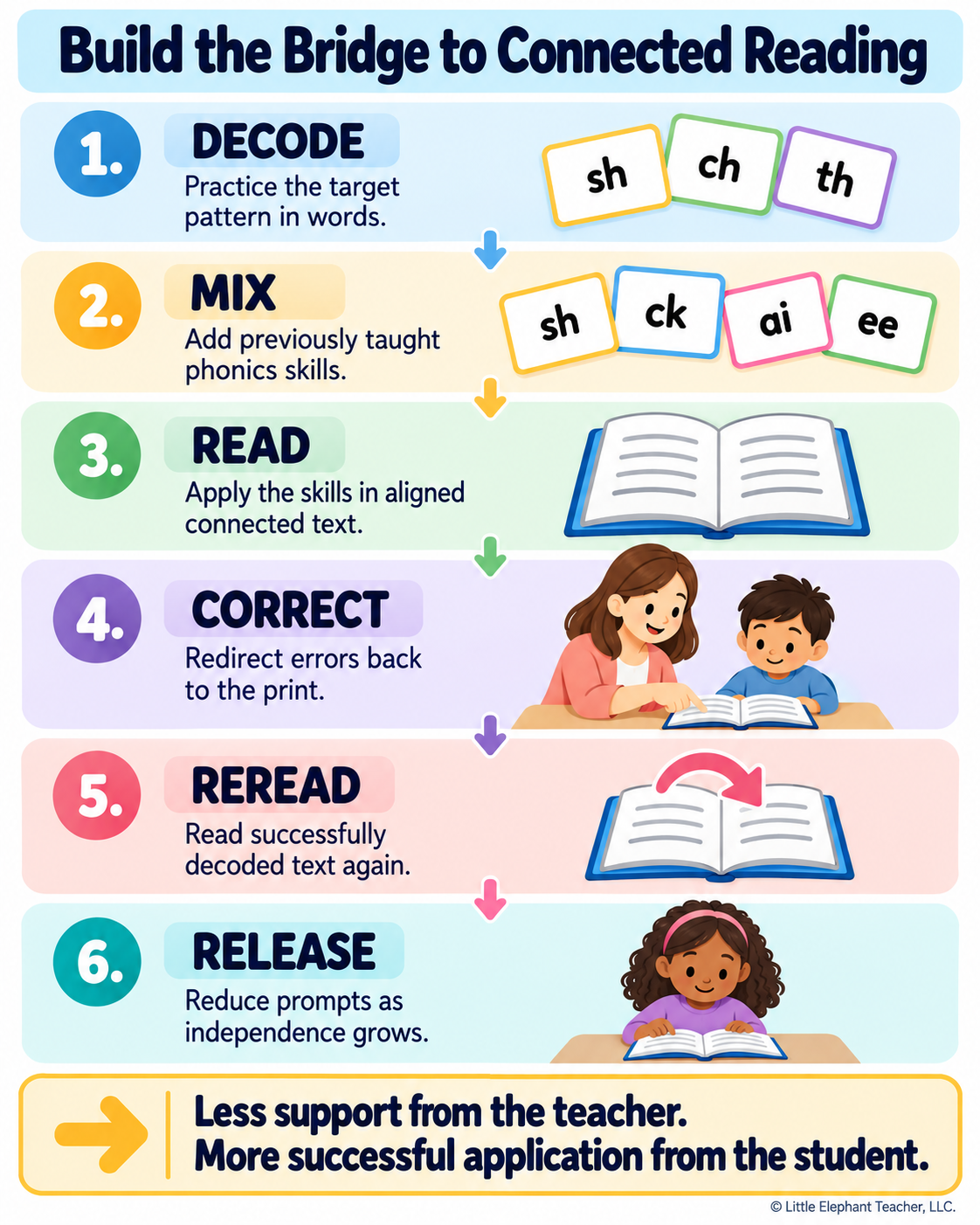
Students build the bridge to connected reading through repeated decoding, cumulative practice, supported application, feedback, rereading, and gradually increasing independence.
And that leads to another important point: if connected text is where the difficulty appears, we do not want to remove connected reading altogether.
Don't Remove Connected Text Just Because It Feels Hard
When a student struggles in a decodable passage, the answer may include more word-level practice.
It may mean the phonics pattern needs additional instruction. It may mean the text needs to be better aligned. It may mean the student needs more support before we expect complete independence.
But connected reading itself still matters.
If connected text is where the skill breaks down, students need supported opportunities to practice the skill there—not only more success in isolation.
The What Works Clearinghouse recommends connected-text reading as part of foundational-skills instruction while students are developing word-reading skills, with modeling, scaffolding, feedback, and opportunities to self-correct.
Read the What Works Clearinghouse foundational-skills practice guide.
At the same time, I do not want to hand a struggling reader a passage where nearly every line requires teacher rescue.
If that happens, I also need to ask whether the text is appropriately matched to the phonics knowledge the student has been taught.
There is a difference between productive difficulty and asking a student to read text they do not yet have the phonics knowledge to access.
Decodable text also serves a specific purpose within reading instruction. It gives students an opportunity to apply developing phonics knowledge in connected reading.
It does not replace rich teacher read-alouds, vocabulary instruction, knowledge building, discussion, or comprehension work.
So if students are beginning to build this bridge, what should progress actually look like?
What Does Progress From Word Lists to Connected Text Look Like?
One reason this matters so much is that progress does not always sound fluent right away.
If we only look for fast reading, we may miss important changes in independence.
Teacher-Dependent
At first, the student reaches boat and waits.
I have to say:
“What sound does oa make?”
I am initiating the decoding process.
The student may successfully read the word after my prompt, but they are still relying heavily on me to tell them what to notice.
Prompted Application
Later, the student pauses at boat.
Instead of identifying oa, I say:
“Check that word.”
The student goes back, notices the vowel team, decodes the word, and continues.
That is progress.
I gave less information, and the student did more of the work.
Independent Application
Eventually, the student encounters float.
They pause, look through the word, work it out correctly, and continue reading.
I did not prompt.
The reading may still sound slower than we ultimately want, but the student independently initiated the decoding process.
That matters.
Increasingly Automatic Application
Over time, many practiced patterns and words begin to require less effort.
The student no longer stops at every familiar pattern. Connected reading begins to sound smoother, and more attention can remain on the sentence and its meaning.
Progress is not simply faster reading.
I am looking for:
increasing accuracy,
less teacher support,
more successful self-correction,
application to unfamiliar words,
smoother rereading,
and greater independence.
Building that independence takes enough aligned practice.
And that is often where the challenge shifts from knowing what students need to actually having enough appropriate practice ready to use.
Having Enough Aligned Phonics Practice Ready to Use
Knowing what a student needs next is one thing.
Having all of the pieces ready to provide that practice is another.
For one phonics skill, I may want students to have opportunities for:
targeted decoding,
cumulative review,
spelling or encoding,
connected reading,
purposeful rereading,
comprehension,
and progress monitoring.
Those pieces are much easier to use when they actually match the skill I am teaching.
Otherwise, intervention teachers can end up searching for a word list in one place, finding a passage somewhere else, creating a spelling activity, and trying to make everything line up.
Once you know what your students need, you should not have to search for and piece together every part of that practice yourself.
If you already use UFLI Foundations, you do not necessarily need another phonics sequence.
What you may need is more opportunity for students to practice and apply the skills from each UFLI lesson.
That is where my UFLI-Aligned ENDLESS Bundle fits.
It includes five decodable passages with comprehension questions for each lesson, along with student workbook practice, progress monitoring, irregular-word support, word lists, and other lesson-aligned resources.
Those passages are especially useful when a student can demonstrate a skill during instruction but needs more opportunities to apply that skill during connected reading.
Explore the UFLI-Aligned ENDLESS Bundle
Little Elephant Teacher® UFLI-aligned resources are supplemental and are not endorsed by or affiliated with UFLI Foundations.
Which Phonics Support Fits Your Classroom?
The best next step depends on what you are already using for instruction.
I Use UFLI Foundations
If you already follow the UFLI Foundations sequence but your students need additional opportunities to practice and apply each lesson's skills, the UFLI-Aligned ENDLESS Bundle gives you more aligned practice without changing the sequence you already use.
The bundle includes student workbook practice, decoding and spelling opportunities, five decodable passages with comprehension questions for each lesson, progress monitoring, irregular/heart-word support, word lists, and other lesson-aligned resources.
For the student who can read the target words during instruction but still needs repeated opportunities to apply that phonics knowledge during connected reading, the additional decodable passages give you a practical way to build that bridge.
You do not have to search for separate texts and hope they match the skill you just taught.
Explore the UFLI-Aligned ENDLESS Bundle
I Need a Complete Skill-by-Skill Phonics Intervention
If you are not following UFLI and need both explicit instruction and aligned practice, my Phonics Intervention Bundle is the better fit.
It provides structured, systematic phonics intervention with explicit skill instruction, decoding and blending, phoneme-grapheme mapping, connected-text application, fluency, student practice, and progress monitoring.
Instead of supplementing an existing sequence, this option provides the intervention instruction and aligned practice organized by phonics skill.
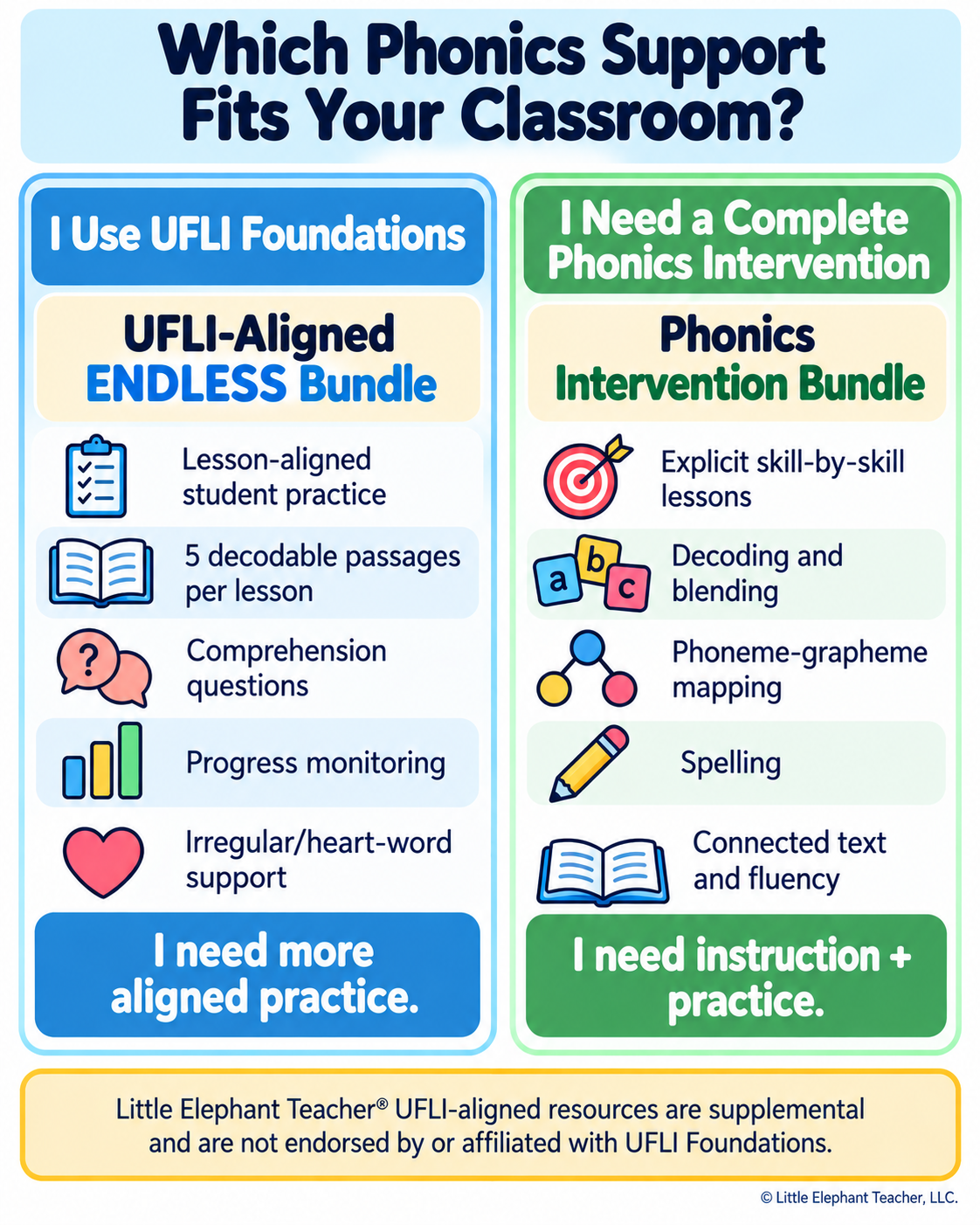
Choose the phonics support that matches the instructional path you already use.
Final Thoughts: Help Students Build the Bridge From Knowing to Reading
When a student reads ship correctly on a word list and then pauses at the same pattern in a passage, I do not want to immediately assume that everything we taught disappeared.
I want to look more closely.
Can the student decode the pattern accurately at the word level?
Can they retrieve it when it is mixed with other phonics skills?
Can they apply it in connected text?
How much prompting do they need?
What happens when I reduce that support?
The student may need additional opportunities to:
decode it → retrieve it among other patterns → apply it in connected text → receive feedback → reread → do more of the work independently
Knowing a phonics skill and automatically applying it while reading are different stages of learning. For many intervention students, we have to intentionally build the bridge between the two.
That bridge is built through practice—not by asking students to memorize another rule, guess at the word, or remain in isolated word lists indefinitely.
If you use UFLI Foundations and your students need more opportunities to make that connection, the UFLI-Aligned ENDLESS Bundle gives you lesson-aligned practice and five decodable passages with comprehension questions for each lesson so you do not have to create and piece together that connected-text practice yourself.
Frequently Asked Questions
Why can a student read words but not sentences?
Word lists narrow the student's attention to individual words and often make the target phonics pattern predictable.
Connected text requires the student to retrieve phonics knowledge while moving across different words and keeping track of the sentence's meaning. A student can therefore demonstrate a phonics skill during word practice and still need more support applying it independently during reading.
Difficulty in sentences does not automatically mean the student learned nothing. Look at whether the student can decode the pattern accurately at the word level, how much support they need in connected text, and whether their independence improves with practice.
Does sounding out every word mean a student doesn't know phonics?
No.
Sounding out unfamiliar words is an important decoding strategy for beginning and struggling readers.
A student who slowly but independently decodes a word is showing something different from a student who cannot access the phonics pattern without teacher help.
Over time, watch whether previously taught patterns and familiar words become easier to recognize and whether the student needs less prompting.
The goal is not to stop students from sounding out words. The goal is for accurate decoding to become increasingly efficient.
Should students master word lists before reading decodable text?
No.
Students need enough phonics knowledge to access the text, but they do not need to wait until every skill is effortless before reading connected text.
Appropriately matched decodable text gives students opportunities to apply the phonics knowledge they are developing during actual reading.
Should students reread decodable passages?
Purposeful rereading can give students another opportunity to read text they have already worked through accurately and practice reading it with increasing ease.
The goal is not to race through the passage or focus only on speed. Rereading should follow accurate decoding and give students another successful encounter with connected text.
The Florida Center for Reading Research includes rereading decodable text as a connected-text fluency activity designed to build speed and accuracy.
See the Florida Center for Reading Research rereading activity.

About the Author
Andrea Russman is a Title I reading intervention teacher and the curriculum creator behind Little Elephant Teacher®. She creates practical, research-informed phonics intervention resources, UFLI-aligned practice materials, and progress-monitoring tools to help elementary teachers support struggling readers with targeted, effective instruction.