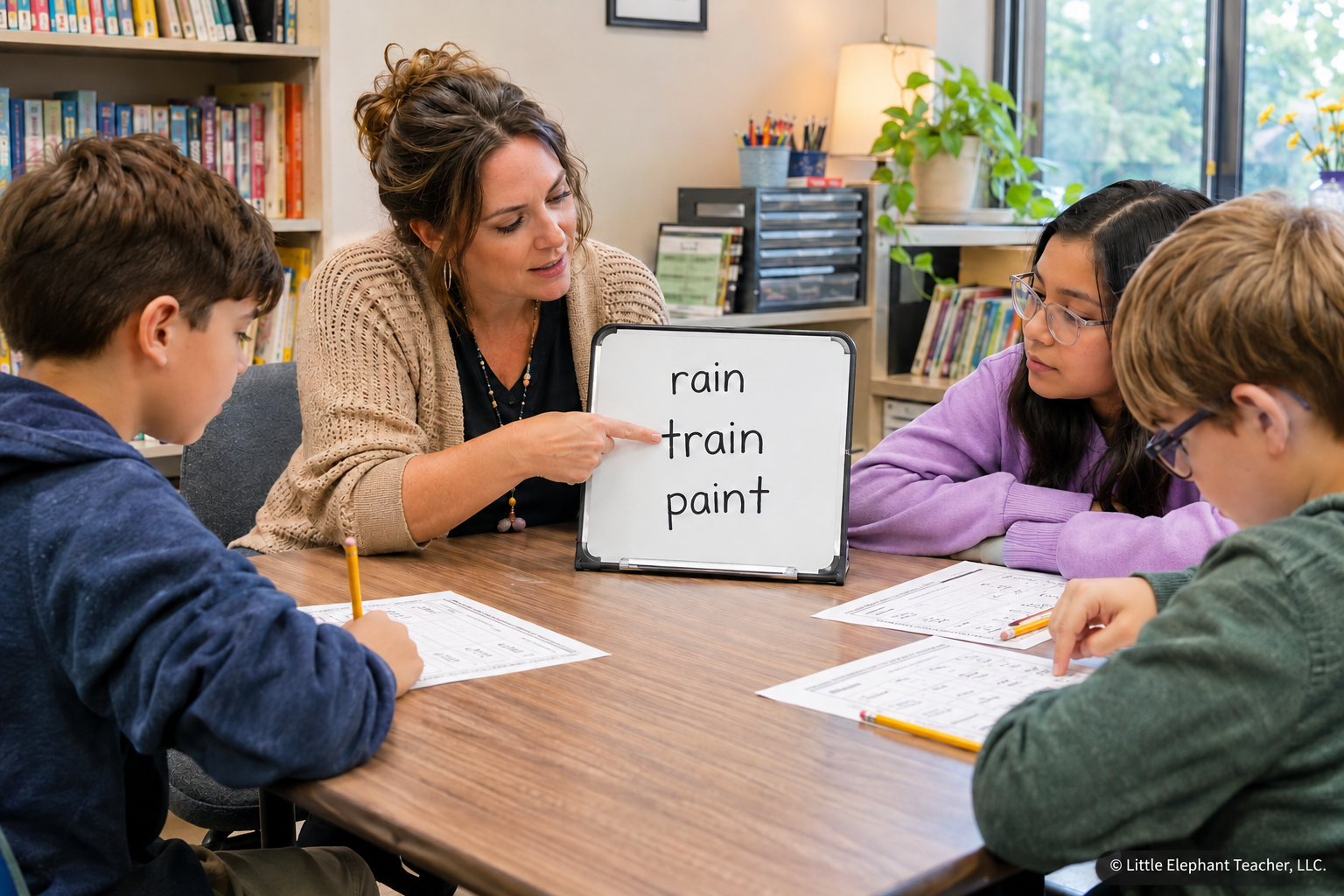
Older students can receive explicit foundational phonics instruction using materials and routines that respect their age.
Teaching phonics to older struggling readers comes with a unique challenge. You know your students need foundational reading instruction, but materials designed for kindergarten and first grade may not feel appropriate for students in third, fourth, or fifth grade.
Maybe you have a fourth grader who can discuss a story but struggles to decode unfamiliar words. Or a fifth grader who recognizes familiar words but guesses when encountering longer, multisyllabic words.
Perhaps your students have received years of reading instruction, yet certain phonics patterns still are not automatic.
Older struggling readers do not need to skip foundational skills simply because they are older. They need instruction that meets their reading needs while respecting their age, experiences, and growing independence.
The goal is not to make phonics instruction harder just because students are older. It is to make instruction more targeted, explicit, efficient, and age-respectful.
Let's look at how to provide that support during small-group phonics intervention.
Why Do Older Students Still Struggle With Phonics?
By third, fourth, or fifth grade, students are expected to read increasingly complex texts independently. Classroom instruction often places greater emphasis on vocabulary, comprehension, writing, and learning from grade-level material.
However, some students are still developing accurate and automatic word-reading skills.
You might notice students who:
Guess unfamiliar words using the first letter or surrounding sentence.
Recognize familiar words but struggle to decode new words.
Have difficulty blending sounds together smoothly.
Confuse vowel patterns or omit sounds when reading.
Read individual words correctly but struggle to apply those skills in connected text.
Have difficulty reading longer, multisyllabic words.
Read so slowly or effortfully that understanding the text becomes difficult.
These behaviors do not all indicate the same instructional need.
A student who struggles to recognize vowel teams may need different instruction from a student who reads single-syllable words accurately but has difficulty decoding longer words.
That is why effective phonics intervention should address the specific word-reading skills students have not yet mastered rather than their grade level alone.
The What Works Clearinghouse guide Providing Reading Interventions for Students in Grades 4–9 recommends building students' ability to decode complex multisyllabic words. It also recommends purposeful fluency-building activities, comprehension instruction, and supported opportunities to engage with challenging text.
Phonics is not the only component of reading. Older students may also need support with vocabulary, language comprehension, fluency, or other reading skills.
But when foundational decoding weaknesses are present, students still need explicit instruction that addresses those weaknesses.
Free Resource: Start With a Phonics Screener
Not sure which foundational phonics skills your students have mastered? A phonics screener can help you identify potential gaps that may need closer assessment and targeted instruction.
Learn more about the Quick Phonics Screener and access the free resource.
1. Teach the Missing Phonics Skill, Not the Student's Grade Level
One mistake we can make when teaching older struggling readers is assuming students should begin with advanced phonics patterns simply because they are in upper elementary grades.
Consider a fourth-grade student who struggles with vowel teams.
Moving directly into complex multisyllabic words may create unnecessary frustration if the student cannot consistently recognize and apply familiar vowel patterns in shorter words.
Instead, the student may benefit from focused instruction and practice with the specific patterns causing difficulty.
For example, a student working on the ai spelling for long /ā/ might practice:
Word reading: rain, mail, train, paint.
Spelling: Listening for the sounds in each word and representing them with letters.
Word mapping: Connecting phonemes to the graphemes that represent them.
Connected text: Reading sentences that reinforce the pattern alongside previously taught skills.
The instructional target is determined by what the student needs to learn, not simply by the grade printed on the student's report card.
This does not mean older students should repeat every beginning phonics lesson.
Instruction should build on what students already know, address demonstrated gaps, and move forward as students develop the necessary skills.
Related Reading: How to Group Students for Phonics Intervention: Why Skill Needs Matter More Than Reading Levels
Help Older Students Apply Foundational Phonics Skills to Multisyllabic Words
For many older struggling readers, the challenge extends beyond reading individual, single-syllable words.
A student may recognize familiar vowel patterns but struggle to apply that knowledge when encountering longer words.
For example, a student who can read rain may still need support reading raincoat or training.
With raincoat, the teacher can model how to recognize the two familiar words, rain and coat, read each part, and blend them together.
With training, students can identify the base word train and the suffix -ing. They can then practice reading the complete word while attending to its syllables.
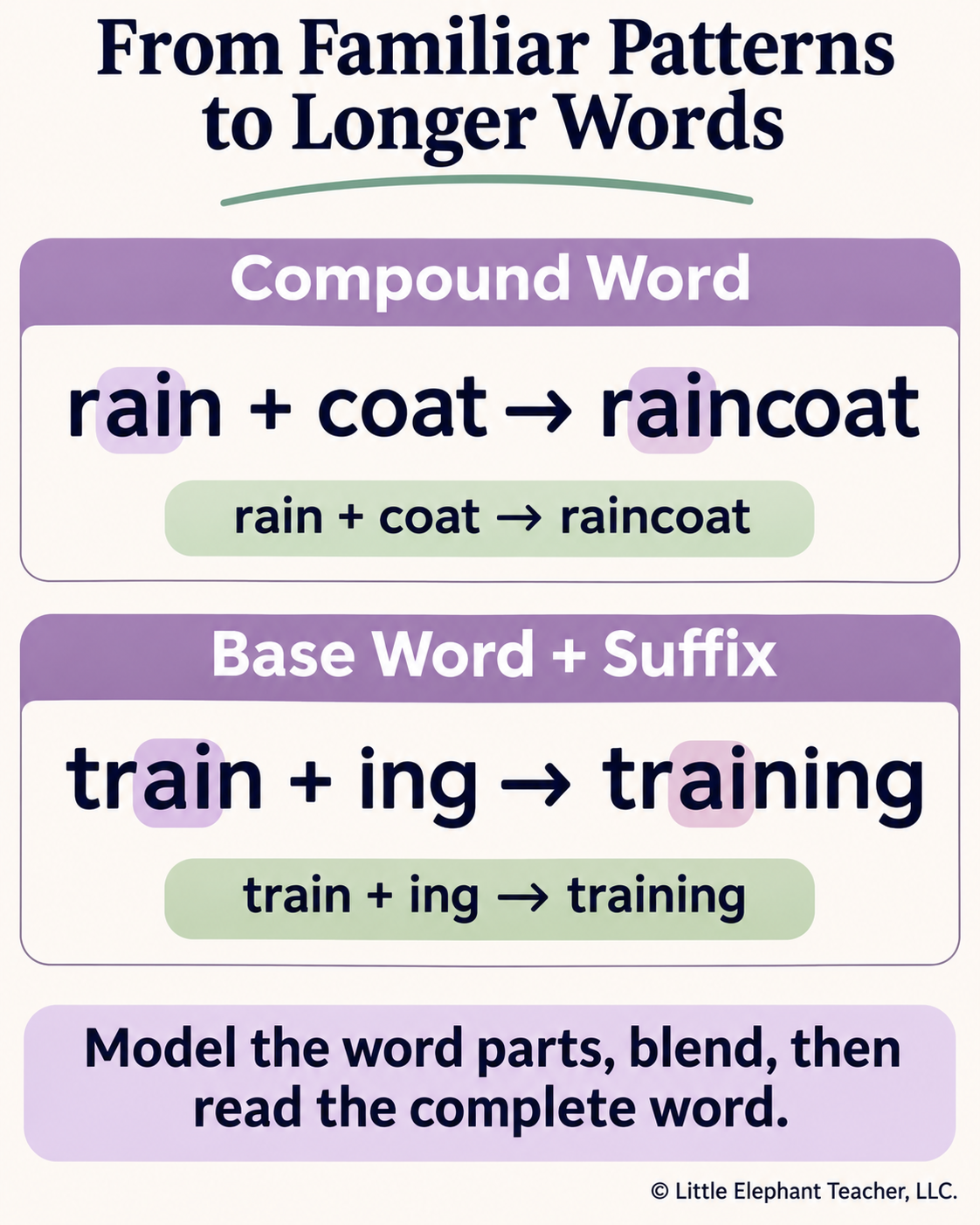
Familiar sound-spelling patterns and recognizable word parts can help older readers approach longer words.
As students gain the necessary foundational knowledge, instruction can expand to longer words containing different syllable types, including closed, open, silent-e, r-controlled, vowel-team, and consonant-le syllables.
Students may also benefit from instruction in common prefixes, suffixes, and other meaningful word parts.
For unfamiliar multisyllabic words, teachers can explicitly model a consistent word-reading routine, provide guided practice, and gradually help students use the routine more independently.
Rather than guessing from the first few letters, students learn to attend to spelling patterns and recognizable word parts throughout the word.
This is particularly important for older students because multisyllabic words appear frequently in the texts they encounter across subject areas.
The What Works Clearinghouse's grades 4–9 reading intervention guide assigns a strong evidence rating to instruction designed to build students' ability to decode complex multisyllabic words.
Looking for Structured Multisyllabic Word-Reading Practice?
If your older students are ready to work on longer words but still need targeted instruction and practice, my Multisyllabic Words Reading Comprehension Passages and Lessons – Syllable Types resource provides coordinated activities focused on syllable patterns.
It includes multisyllabic word lists, syllable-mapping activities, word cards, fluency sentences, reading passages with comprehension questions, a placement assessment, and 45 progress-monitoring assessments.
These materials provide opportunities for students to apply multisyllabic decoding skills in individual words, sentences, and connected reading.
The goal is not to keep older students working on beginning phonics longer than necessary. It is to strengthen missing foundations and help students apply those skills to increasingly complex words.
2. Make Phonics Instruction Age-Respectful, Not Unnecessarily Difficult
Older students often recognize when instructional materials look like they were designed for much younger children.
Large cartoon characters, preschool-style activities, and overly simplified themes may feel uncomfortable for some students, even when the phonics skill itself is appropriate for their needs.
However, age-respectful instruction does not mean eliminating the scaffolds that support learning.
A fourth grader who struggles with CVC words may still need explicit instruction and practice with those words.
The difference is how the instruction is presented.
The skill can be foundational while the presentation remains age-appropriate.
What Age-Respectful Phonics Materials Look Like
When selecting phonics intervention materials for older students, look for:
Clean, organized pages without unnecessarily childish decorations.
Clear instructions and predictable routines.
Appropriate words, sentences, and reading topics.
Explicit instruction without excessive transitions.
Meaningful decoding and spelling practice.
Opportunities for students to explain their thinking and notice patterns.
Materials that allow students to practice without drawing unnecessary attention to their reading difficulties.
These considerations do not replace instructional quality. They help teachers present foundational skills respectfully.
For older students, the goal is to make materials accessible without making the learning experience feel childish.
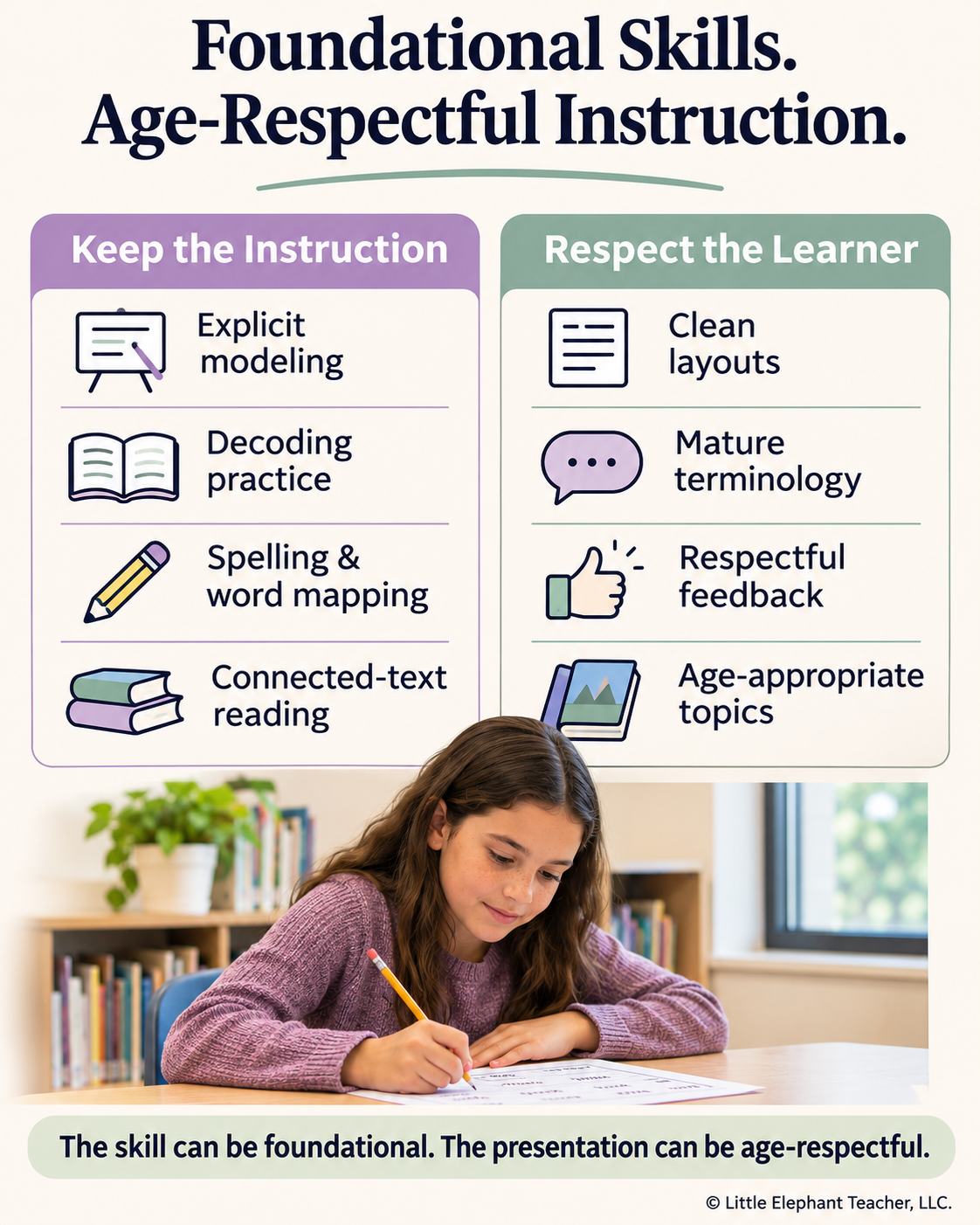
Foundational phonics instruction can remain explicit and supportive while using language and materials appropriate for older learners.
How to Talk About Foundational Reading Skills With Older Students
Age-respectful phonics instruction also includes the language teachers use.
For example, an older student may need instruction with r-controlled vowels, but that does not mean the lesson needs to rely on characters, songs, or informal descriptions commonly used with younger children.
Instead, you might say:
"Today we're working on r-controlled vowels. The letter r can change how the preceding vowel is pronounced. Let's look at how this works in words."
Or, when introducing a familiar sound-spelling pattern:
"We're going to practice recognizing this pattern accurately so it becomes easier to read unfamiliar words."
The instruction remains explicit and accessible, but the language communicates respect for the student's age.
The What Works Clearinghouse guidance for grades 4–9 emphasizes explicit instruction to strengthen older students' word-reading skills. Using clear, accurate language during instruction helps students focus on the phonics skill while respecting their age and experience.
Age-respectful instruction is not about making phonics more complicated. It is about providing necessary support in a way that respects the learner receiving it.
3. Use Short, Explicit, and Predictable Phonics Intervention Routines
Older struggling readers often benefit from a clear instructional routine that reduces unnecessary transitions and provides frequent opportunities to respond.
Instead of introducing several unrelated phonics skills during one intervention session, focus on a carefully selected target and give students multiple opportunities to apply it.
In my work as a Title I reading interventionist, I often see students who can identify a phonics pattern during instruction but struggle to apply that same knowledge when reading unfamiliar words or connected text.
Some students also need additional support with blending sounds smoothly rather than reading each sound separately and struggling to put them together.
Because my intervention blocks are only 20 minutes, I have to be intentional about how we use that time.
I rely on predictable routines, explicit modeling, guided decoding, and opportunities for students to write words and connect sounds to spellings. I also want students to apply what we practice to actual reading.
For my older students, another important consideration is how the instruction is presented. They still need the foundational skill, but the materials and teacher language should respect their age.
What a Focused 20-Minute Phonics Intervention Can Include
When time is limited, a predictable lesson routine can help keep instruction organized.
One possible session might include:
Brief review (2 minutes): Revisit previously taught sound-spelling relationships.
Explicit modeling (3 minutes): Introduce or review the target pattern and demonstrate how to apply it.
Guided decoding (4 minutes): Read and blend words containing the target skill.
Encoding and word mapping (4 minutes): Connect spoken sounds to spellings and practice writing words.
Connected-text reading (5 minutes): Apply the target skill in sentences or passages.
Feedback and review (2 minutes): Reinforce accurate responses and revisit difficulties.
This is an illustrative routine, not a required schedule or sufficient dosage for every student.
Some students may need more explicit modeling, additional blending support, or a longer period of guided practice. Students with persistent reading difficulties may require more intensive instruction or additional intervention time.
Feedback should also occur throughout the lesson rather than only during the final two minutes.
The important part is the instructional approach: teach clearly, provide supported practice, and help students apply what they are learning.
Consistency helps students understand expectations and keeps intervention time focused on meaningful reading and spelling practice.
4. Connect Decoding, Spelling, and Word Mapping
Older struggling readers may have spent years practicing word recognition without developing accurate and automatic connections between sounds and spellings.
That is why phonics intervention should include opportunities to connect decoding, spelling, and phoneme-grapheme mapping.
These activities reinforce related aspects of word reading.
When decoding, students connect written graphemes to phonemes and blend the sounds together.
When spelling, they segment spoken words into phonemes and select the graphemes that represent those sounds.
Word mapping helps students attend carefully to these relationships.
Example: Reading, Mapping, and Spelling a Word With a Vowel Team
Consider the word train.
The word contains five letters but four phonemes:
/t/ /r/ /ā/ /n/
Those sounds are represented by four graphemes:
t | r | ai | n
The letters ai work together to represent the single long-a vowel sound.
A short instructional sequence might look like this:
Say the word: Have students listen to and repeat train.
Segment the sounds: Guide students to identify /t/ /r/ /ā/ /n/.
Map the sounds: Connect the four phonemes to their corresponding graphemes.
Read the word: Blend the sounds to read train.
Spell the word: Have students write the word from dictation.
Read it again: Return to the printed word and practice accurate, smooth reading.
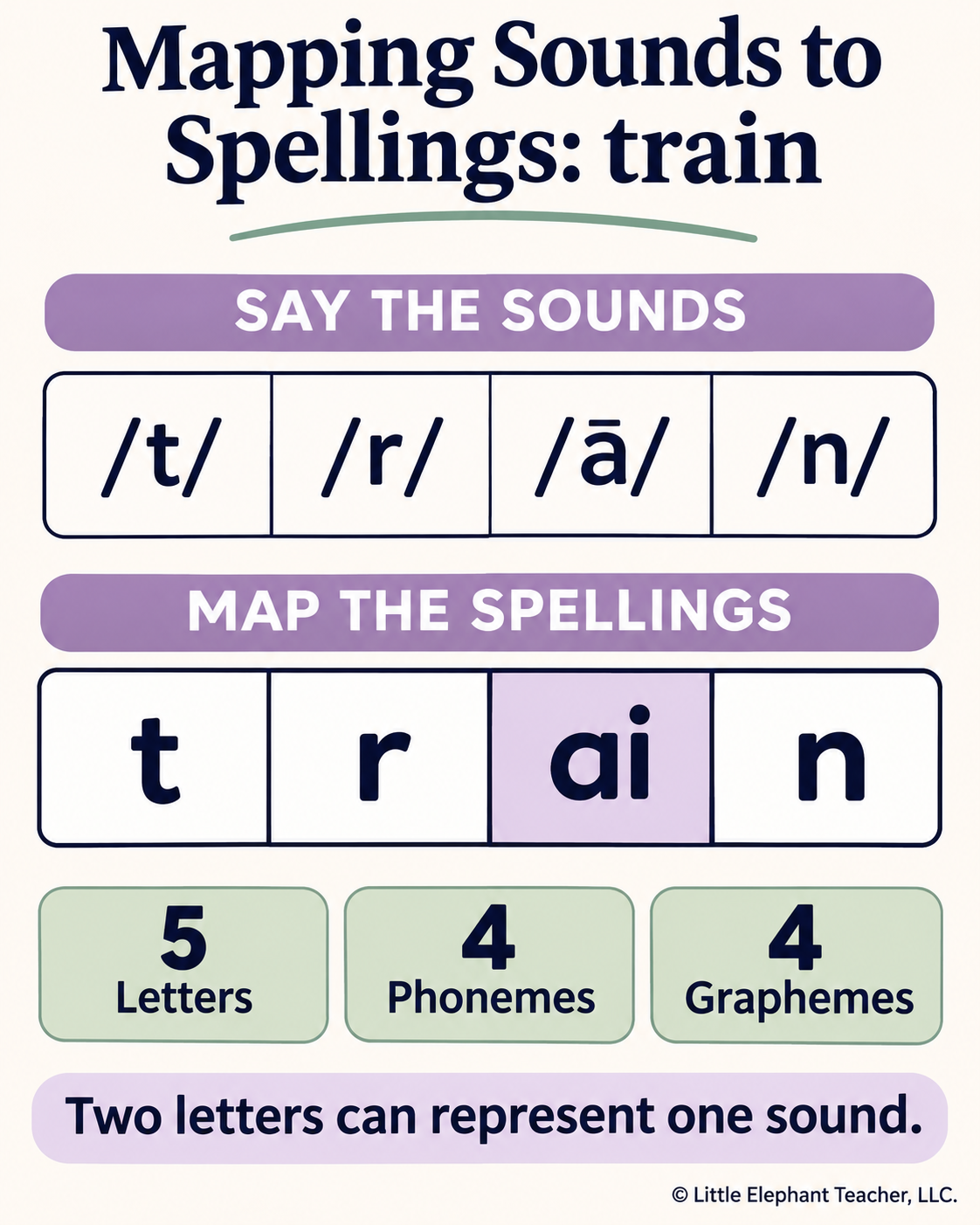
The word train contains five letters but four phonemes. The vowel team ai represents one sound.
Notice that the vowel team ai represents one phoneme even though it contains two letters.
When using sound boxes or mapping activities, students should attend to the actual spoken sounds rather than assigning a separate sound to every printed letter.
For older students, these activities can remain simple and efficient. A whiteboard, structured student practice page, and carefully selected words can provide meaningful opportunities to apply sound-spelling knowledge.
The What Works Clearinghouse grades 4–9 guide recommends incorporating spelling activities into instruction for students learning to decode multisyllabic words.
Why Coordinated Practice Matters
Identifying the phonics skill your students need is only the beginning.
Students also need opportunities to apply that skill through decoding, spelling, word mapping, and connected reading.
The Little Elephant Teacher® Phonics Intervention Bundle organizes explicit instruction and student practice around targeted phonics skills.
Instead of gathering disconnected activities, teachers can use a consistent lesson structure that connects word-level practice to text.
5. Give Older Readers Opportunities to Apply Phonics Skills in Connected Text
A student may successfully read a list of words containing a particular phonics pattern but still struggle when those words appear in sentences or passages.
This does not necessarily mean the student has forgotten the skill.
Connected reading introduces additional demands. Students must recognize words in sequence, maintain accuracy, attend to meaning, and continue reading without losing their place.
For older struggling readers, this transition is especially important because the ultimate goal is not simply to read isolated words correctly.
The goal is to use accurate, increasingly automatic word reading to support meaningful reading.
After practicing a phonics pattern in individual words, provide connected text that allows students to apply that pattern.
For example, after students have learned the ai vowel team and the other necessary spelling patterns, they might read:
"The train came in the rain."
The words train and rain reinforce the target vowel team. Other words in the sentence should already be familiar, decodable using previously taught patterns, or appropriately supported.
As students become more accurate and confident, gradually increase the complexity and length of the text.
Choose Decodable Text That Matches the Skill and Respects the Reader
When choosing text for older struggling readers, consider both instructional control and age appropriateness.
Look for:
Opportunities to practice the target phonics skill.
Previously taught spelling patterns.
Appropriate language and sentence structures.
Topics and illustrations that respect students' maturity.
Opportunities to discuss and understand what was read.
Decodable passages serve a particular instructional purpose: they give students opportunities to apply taught phonics knowledge in connected reading.
However, they should not be the only texts older struggling readers encounter.
Students also need access to rich vocabulary, complex ideas, grade-level content, and meaningful discussions through read-alouds and other supported experiences.
The What Works Clearinghouse grades 4–9 guide recommends opportunities for students to engage with challenging text while receiving appropriate comprehension support.
Targeted decoding practice and access to meaningful, challenging reading experiences should work together—not compete with one another.
Related Reading: Students may read phonics patterns accurately in word lists but still struggle to apply those skills in sentences and passages. If you're noticing this during intervention, read Why Can My Student Read Word Lists but Struggle With Decodable Text? for practical ways to bridge word-level decoding and connected reading.
6. Build Fluency Without Rushing Students Through Words
When older students read slowly, it can be tempting to focus immediately on speed.
However, asking a student to read faster does not resolve an underlying decoding difficulty.
A student who is still guessing at unfamiliar words or confusing vowel patterns needs opportunities to strengthen accurate word reading.
Fluency includes accuracy, appropriate rate, and expression.
The goal is not simply to finish a passage as quickly as possible.
Use Supported Rereading and Specific Feedback
Begin with words and passages that match the student's instructional needs.
Model accurate reading, provide guided practice, and give specific feedback when errors occur.
A fluency-building routine might include:
The student reads a short passage containing taught phonics patterns.
The teacher provides specific feedback when decoding errors occur.
The student practices words or patterns that caused difficulty.
The student rereads the passage with a clear purpose, such as improving accuracy, phrasing, or expression while attending to meaning.
Purposeful rereading gives students opportunities to become more familiar with the words and patterns they are learning.
The What Works Clearinghouse's grades 4–9 guide identifies purposeful fluency-building activities as a strong-evidence recommendation and cautions against focusing excessively on speed.
For older struggling readers, fluency practice should support increasingly accurate, automatic, and meaningful reading—not create unnecessary pressure to read quickly.
Related Reading: What to Say When a Student Reads a Word Incorrectly: Corrective Feedback for Decoding Errors
7. Keep Every Part of Phonics Intervention Connected to the Same Skill
One challenge with planning phonics intervention for older students is finding materials that work together.
You might have a word list from one resource, a spelling worksheet from another, and a reading passage that introduces patterns your students have not yet learned.
Even when each activity looks helpful individually, instruction becomes harder to coordinate when the materials do not reinforce the same target.
For example, if your group is working on vowel teams, you want the lesson, decoding practice, spelling activities, word mapping, and connected text to provide opportunities to apply those patterns.
When the materials align, students can encounter the same target skill in different tasks rather than completing unrelated activities.
This is especially valuable when intervention time is limited.
Why a Complete, Skill-Organized Intervention Resource Can Help
The Little Elephant Teacher® Phonics Intervention Bundle provides structured phonics lessons and student practice organized by skill.
The current resource includes:
226 complete phonics lessons.
Explicit lesson plans and scripted routines for decoding, blending, and corrective feedback.
Four consistent student practice pages per lesson.
Phoneme-grapheme mapping and word-reading activities.
Decodable-text application and fluency practice.
57 progress-monitoring assessments.
Phonics rule guides, letter cards, and mapping tools.
Its 12-unit progression moves from foundational letter-sound relationships and CVC words through blends, digraphs, silent e, r-controlled vowels, vowel teams, diphthongs, prefixes, and suffixes.
You do not have to start every student at Lesson 1 or repeat skills they already know. The goal is to select instruction that matches students' demonstrated needs.
For older students with foundational decoding gaps, the familiar lesson structure and coordinated practice can help make small-group planning more manageable.
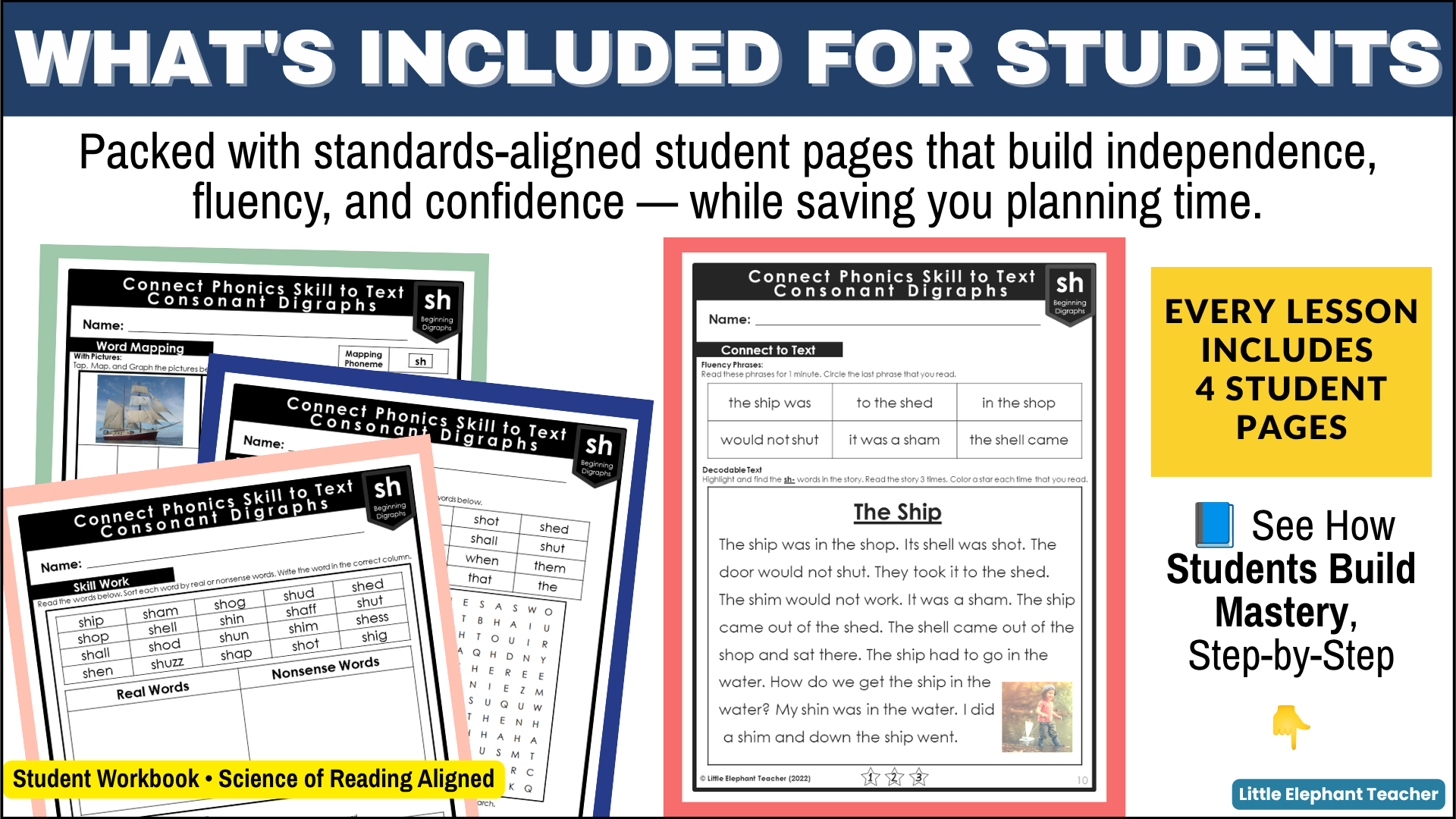
The Phonics Intervention Bundle organizes explicit lessons and student practice around targeted foundational phonics skills.
Explore the Complete Phonics Intervention Bundle
8. Help Older Struggling Readers Recognize Their Progress
Students who have experienced reading difficulties for several years may begin to doubt their abilities.
That makes it especially important to recognize specific reading behaviors and improvements rather than focusing only on grade-level expectations.
Instead of simply saying, "Good job," identify what the student did successfully.
You might say:
"Last week, you needed help recognizing that vowel pattern. Today, you noticed it and read the word accurately."
Or:
"I noticed you looked all the way through that word instead of guessing from the first letter."
Or:
"You used the spelling pattern we practiced to read a longer word."
These comments communicate that students are developing specific reading skills.
You can also show progress through meaningful evidence, such as increased accuracy on comparable word-reading tasks or greater independence with a previously challenging pattern.
When monitoring progress, use measures that correspond to the skills being taught and look at patterns over time rather than drawing conclusions from a single response.
Older students need opportunities to recognize their growth as readers, not just reminders of the skills they have not yet mastered.
Which Phonics Support Fits Your Classroom?
Teaching phonics to older struggling readers requires more than finding worksheets that look appropriate for their age.
Students need explicit instruction, meaningful practice, and opportunities to apply the phonics skills they are learning.
The most useful materials are those that fit your instructional approach and the skills your students need.
At Little Elephant Teacher®, there are two main implementation paths.
I Need a Complete Phonics Intervention System
Phonics Intervention Bundle
If you need explicit, skill-by-skill phonics instruction, the Phonics Intervention Bundle provides organized lessons and coordinated practice for foundational reading skills.
With 226 lessons, four student pages per lesson, progress-monitoring assessments, and consistent routines, it is designed to help teachers address foundational phonics gaps without assembling every part of intervention from separate resources.
This option is particularly relevant for teachers working with older students who still need targeted foundational decoding instruction.
My School Uses UFLI Foundations
UFLI-Aligned ENDLESS Bundle
If your school follows UFLI Foundations, the UFLI-Aligned ENDLESS Bundle provides additional resources aligned with the UFLI lesson sequence.
The bundle includes student response workbooks, decodable passages with comprehension questions, progress-monitoring assessments, irregular-word resources, vocabulary support, and other student practice materials.
These resources supplement UFLI instruction rather than replace the UFLI Foundations manual or official lesson guidance.
Explore the UFLI-Aligned ENDLESS Bundle
Final Thoughts: Older Students Deserve Strong Foundational Reading Instruction
Older struggling readers deserve instruction that meets their reading needs without overlooking their age, experiences, or growing independence.
When we identify the missing skills, teach them explicitly, and provide meaningful opportunities to apply them, foundational phonics instruction becomes a pathway forward—not a return to kindergarten.
If you're looking for a consistent, age-respectful approach to foundational phonics instruction, explore the Phonics Intervention Bundle for structured lessons and aligned student practice.
Frequently Asked Questions About Phonics for Older Struggling Readers
Should third, fourth, and fifth graders still receive phonics instruction?
Yes. Older students who have not mastered foundational decoding skills may still need explicit phonics instruction, even when those skills are typically introduced in earlier grades.
Instruction should address the specific sound-spelling patterns or word-reading skills students need rather than automatically following their grade-level expectations. Older students should also continue receiving appropriate vocabulary, comprehension, and grade-level content instruction.
How can I teach phonics to older students without making it feel too young?
Keep the instruction explicit and systematic, but use age-respectful materials, language, and activities.
Choose clean worksheet layouts, appropriate reading topics, clear teacher explanations, and meaningful decoding and spelling practice. Foundational skills can be taught without relying on preschool-style characters, songs, or overly childish activities.
The goal is to respect students' maturity while providing the scaffolding they need.
What phonics skills should older struggling readers learn first?
The starting point depends on the student's demonstrated reading and spelling skills.
Some students may need additional instruction with short vowels, consonant blends, digraphs, or vowel teams. Others may be ready for multisyllabic word-reading instruction involving syllable patterns and meaningful word parts.
A phonics screener and additional targeted assessment can help teachers identify which skills need closer attention.
Avoid restarting every older student at the beginning of a phonics sequence when they have already mastered prerequisite skills.
How do you teach multisyllabic words to older struggling readers?
Begin by identifying the foundational decoding knowledge students can already apply accurately.
Explicitly model how to recognize familiar spelling patterns, identify syllables and meaningful word parts when appropriate, and blend the parts to read the complete word.
Provide guided practice with multisyllabic word lists, spelling activities, and connected text. Gradually reduce support as students become more accurate and independent.
The What Works Clearinghouse guide for students in grades 4–9 identifies multisyllabic decoding instruction as a strong-evidence recommendation.
What should a small-group phonics intervention lesson include for older students?
A focused phonics intervention lesson may include a brief review of previously taught skills, explicit modeling, guided decoding, spelling and phoneme-grapheme mapping, connected-text reading, and specific corrective feedback.
The exact sequence, amount of practice, and instructional time should be adjusted to student needs.
The important consideration is that instruction and practice remain connected to the same target rather than becoming a collection of unrelated activities.
Research Referenced in This Article
What Works Clearinghouse. (2022). Providing Reading Interventions for Students in Grades 4–9. Institute of Education Sciences, U.S. Department of Education.
What Works Clearinghouse. (2016; revised 2019). Foundational Skills to Support Reading for Understanding in Kindergarten Through 3rd Grade. Institute of Education Sciences, U.S. Department of Education.
About the Author
Andrea Russman is a Title I reading intervention teacher and the curriculum creator behind Little Elephant Teacher®. She creates practical, research-informed phonics intervention resources, UFLI-aligned practice materials, and progress-monitoring tools to help elementary teachers support struggling readers with targeted, effective instruction.