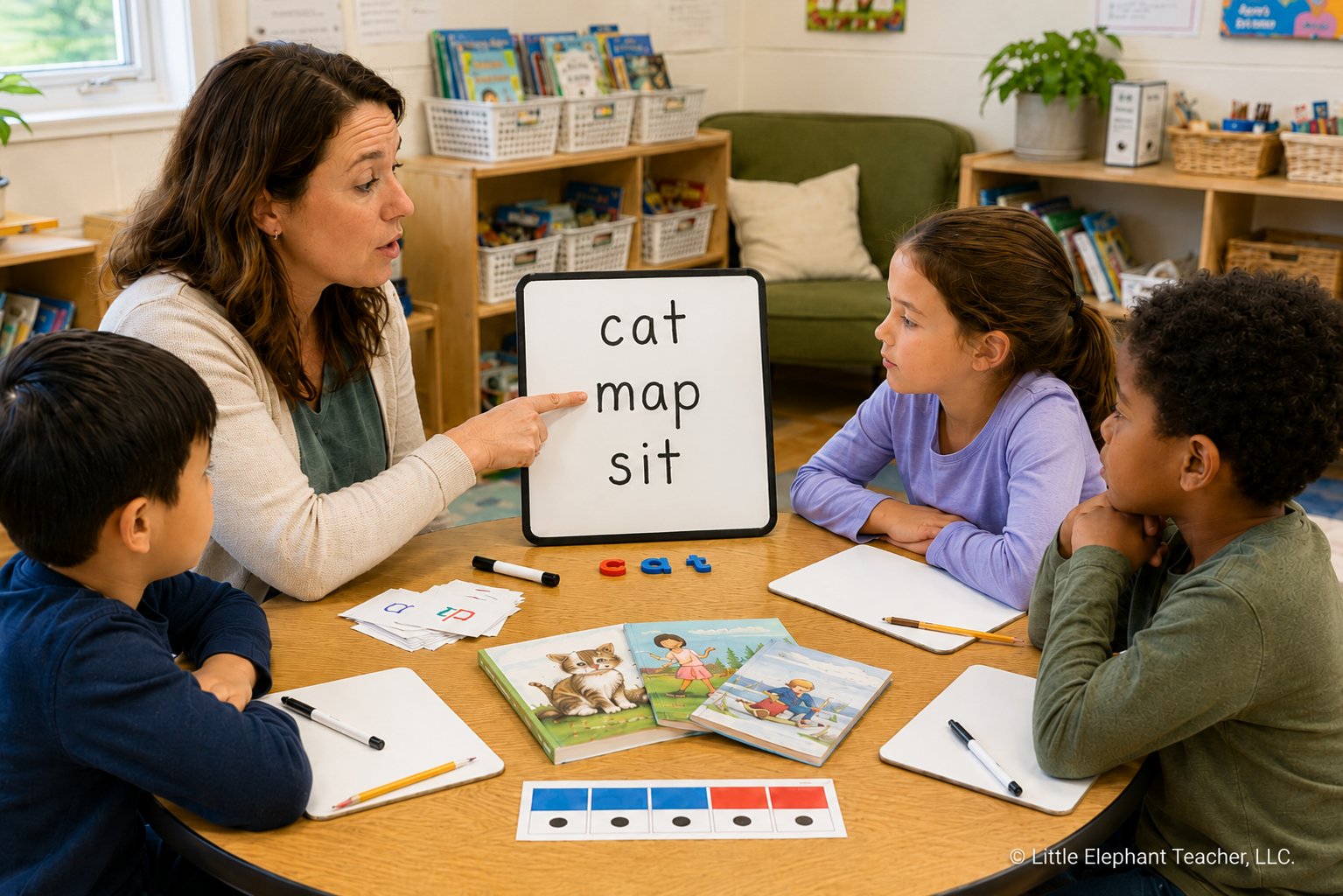
A clear phonics teaching order helps students build decoding skills from simple patterns to more complex ones.
Teaching phonics skills in a clear, cumulative order helps students build on what they already know instead of being asked to read spelling patterns they have not learned yet.
However, many teachers were taught how to teach individual phonics skills without being shown how those skills fit together across a complete progression. As a result, phonics instruction can sometimes feel like a collection of activities, word lists, and worksheets rather than a connected sequence.
That can leave teachers wondering:
What phonics skill should I teach next?
It’s an important question. When students are asked to read words containing unfamiliar spelling patterns, they may begin relying on guessing instead of using their decoding skills.
A clear phonics skill progression gives you a roadmap. It can help you:
plan systematic phonics instruction
identify gaps in student learning
choose appropriate decodable texts
organize small-group intervention
provide targeted support for struggling readers
As a Title I reading teacher, I have seen how much easier planning becomes when phonics instruction follows a clear progression. A sequence does not replace assessment or teacher judgment, but it gives you a helpful place to begin.
At a Glance: A Common Phonics Skill Progression
A common phonics progression begins with phonemic awareness and letter-sound relationships. Students then move into CVC words, the FLOSS rule, digraphs, blends, silent e, r-controlled vowels, vowel teams, diphthongs, prefixes and suffixes, and multisyllabic words.
The exact order may vary by phonics program, so assessment data should always help determine what each student needs to learn next.
This article explains each stage of the progression and how the skills build on one another.
Phonics Skill Progression Overview
Why Phonics Skill Order Matters
Phonemic Awareness
Letter-Sound Relationships
CVC Words and Word Families
The FLOSS Rule
Consonant Digraphs
Beginning Consonant Blends
Ending Consonant Blends
Silent e
R-Controlled Vowels
Advanced Consonants and Silent Letters
Vowel Teams
Diphthongs and Other Vowel Patterns
Prefixes and Suffixes
Multisyllabic Words
Supporting Students With Decodable Practice
How to Know Which Phonics Skill to Teach Next
Frequently Asked Questions
Why Phonics Skill Order Matters
Phonics skills build on one another.
Students begin by hearing and working with sounds in spoken words. They then learn how those sounds connect to letters before gradually moving into more complex spelling patterns.
For example, a student who has only learned short-vowel CVC words will probably struggle to read words such as:
train
boat
shine
bird
Those words require knowledge of vowel teams, silent e, or r-controlled vowel patterns.
When phonics instruction follows a structured sequence, students are more likely to apply the patterns they have already learned. Reading becomes more predictable and manageable because students are not being asked to use skills that have not yet been taught.
I often see the importance of this progression during small-group instruction. When a student reads ship as sip, the error may show that the student needs more practice recognizing the sh digraph. When a student reads stop as sop, the missing sound may indicate that the student needs more support hearing and blending consonant blends.
Those errors give us useful information. They help us determine which skill needs more instruction instead of simply giving the student a different worksheet or asking them to try harder.
A phonics sequence should still be used flexibly. Different programs may introduce certain skills in a slightly different order, and assessment information should always guide instruction.
The goal is not to move through a checklist as quickly as possible. The goal is to give students enough instruction and practice with foundational skills before asking them to apply more complex ones.
Free Printable Phonics Scope and Sequence
To make planning easier, I created a free printable phonics scope and sequence that provides a visual roadmap of how phonics skills commonly build over time.
The printable follows this general progression:
Phonemic awareness → letter sounds → CVC words → FLOSS rule → consonant digraphs → beginning blends → ending blends → silent e → r-controlled vowels → advanced consonant patterns → vowel teams → diphthongs → prefixes and suffixes → multisyllabic words
You can keep the printable nearby while planning whole-group lessons, organizing small-group instruction, or determining which skill to teach next.
For the complete visual progression,download my free Science of Reading phonics scope and sequence.
A Common Order to Teach Phonics Skills
Phonics programs may organize certain skills differently. However, evidence-aligned programs generally move from simpler sound-spelling relationships to increasingly complex patterns.
Here is one common phonics teaching order.
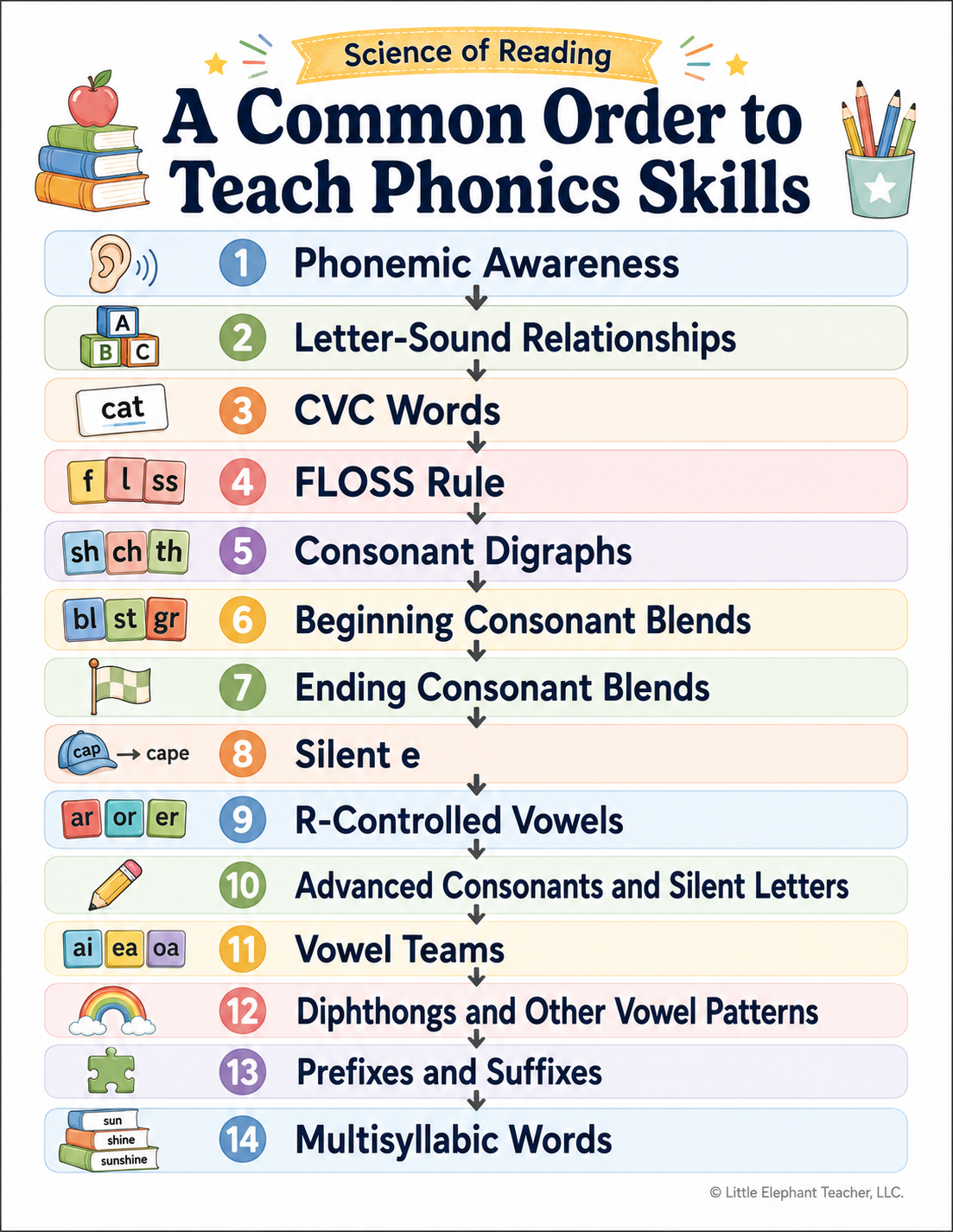
A systematic phonics progression moves from foundational sound skills to increasingly complex spelling patterns.
1. Phonemic Awareness
Before students can connect sounds to letters, they need opportunities to hear and work with the sounds in spoken language.
Phonemic awareness activities are completed orally. Students do not need to look at printed letters or words during these activities.
Students may practice:
identifying the first or last sound in a word
blending individual sounds into a word
segmenting a word into separate phonemes
adding or removing sounds
substituting one sound for another
For example, a teacher might say:
“Listen to the sounds: /m/ /a/ /p/. What word do those sounds make?”
The student blends the sounds and responds:
“Map.”
Phonemic awareness is not the same as phonics, but it provides an important foundation for learning how sounds connect to print.
Phonemic awareness instruction does not need to stop when phonics begins. Students can continue practicing oral sound skills while learning to connect those sounds to letters.
2. Letter-Sound Relationships
Early phonics instruction helps students understand that written letters represent sounds.
Students begin learning:
letter names
letter sounds
how to form letters
how to blend letter sounds into words
how to segment words and connect each sound to a letter
Letters are often introduced in an intentional order rather than alphabetically. Many programs begin with a carefully selected group of consonants and short vowels so students can start blending words as quickly as possible.
The exact letter-introduction order varies by curriculum. Follow the sequence used by your phonics program while making sure students receive frequent opportunities to review previously taught sounds.
Once students know several useful letter sounds, they can begin blending those sounds to read simple words.
3. CVC Words and Word Families
CVC words are often the first words students learn to decode.
CVC stands for:
consonant-vowel-consonant
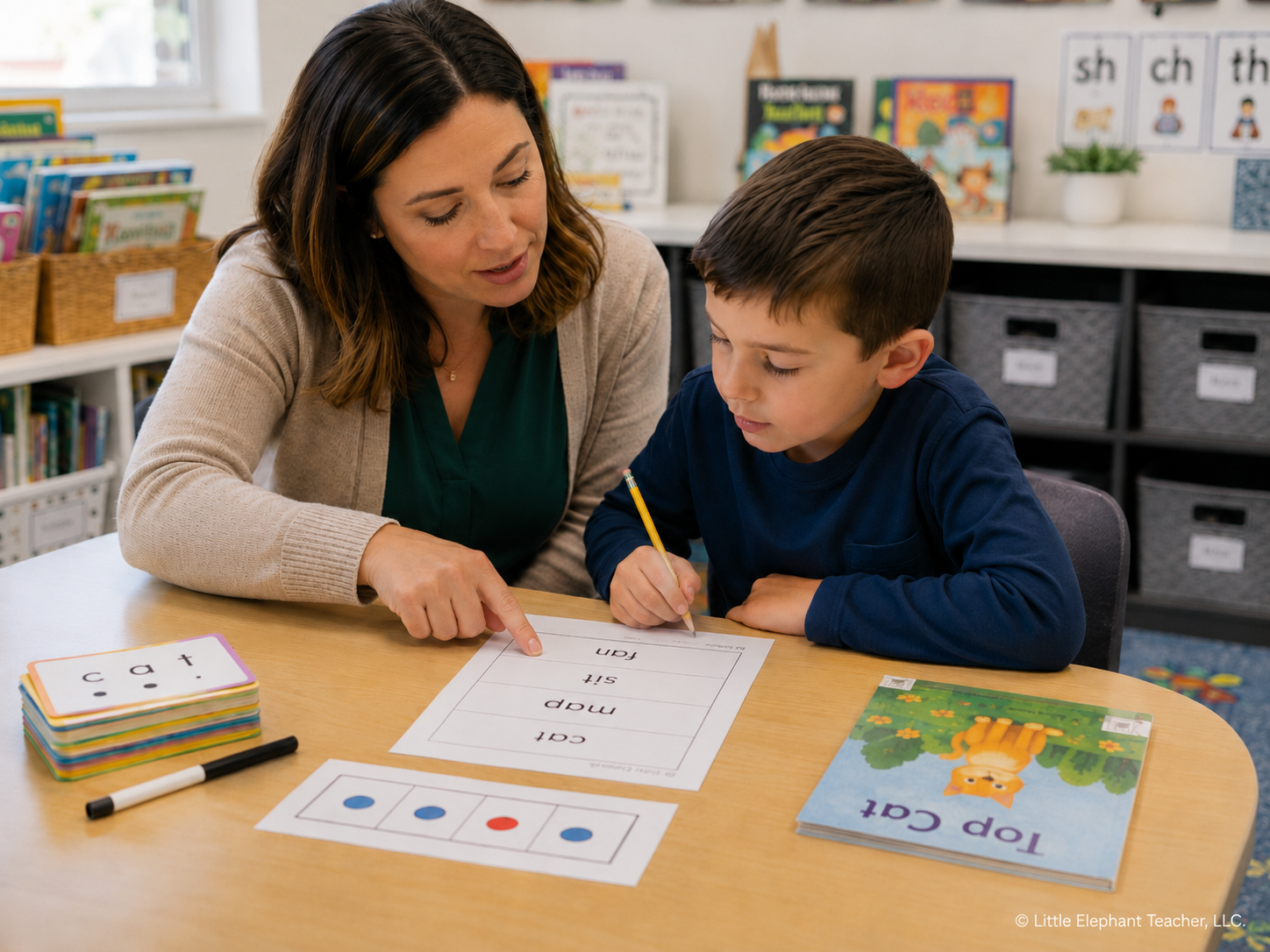
CVC words help students learn that they can use letter sounds to decode a word instead of guessing.
Examples include:
cat
map
fan
sit
bed
hop
sun
At this stage, students practice saying each sound and blending the sounds together to read the complete word.
For example:
/m/ /a/ /p/ → map
This is often the stage when reading begins to click. Students begin to understand that they do not need to memorize or guess the word. They can use the letters and sounds to figure it out.
Students may also begin noticing common word families, including:
-at: cat, hat, sat
-an: fan, man, ran
-it: sit, fit, hit
-op: hop, mop, top
Word-family practice can help students notice similarities among words, but they should still look at and blend through the entire word.
Students also need practice with a variety of short vowels and beginning and ending consonants. This prevents them from relying on one familiar word pattern instead of attending to every sound.
4. Double Consonants: The FLOSS Rule
After students are comfortable reading simple CVC words, they may begin learning the FLOSS rule.
In many one-syllable words, the letters f, l, s, and z are doubled when they immediately follow a short vowel at the end of the word.
Examples include:
off
hill
pass
buzz
fluff
miss
The doubled consonants still represent one sound. In the word hill, for example, the letters ll represent one /l/ sound.
Teaching this pattern helps students read and spell words with final doubled consonants.
5. Consonant Digraphs
A consonant digraph contains two letters that work together to represent one sound.
Common consonant digraphs include:
sh
ch
th
ck
ng
Example words include:
ship
chop
thin
back
sing
Students may initially try to pronounce each letter separately. Explicit modeling helps them understand that the two letters work together.
For example, in the word ship, the letters sh represent one sound:
/sh/ /i/ /p/ → ship
Students should practice identifying digraphs at both the beginning and end of words.
It can also be helpful to compare digraphs with individual consonant sounds. This allows students to see that although there are two letters, the digraph represents only one phoneme.
6. Beginning Consonant Blends
A consonant blend contains two or more consonants next to one another. Unlike a digraph, each consonant sound can still be heard.
Examples of beginning blends include:
st in stop
fl in flag
dr in drum
sw in swim
cl in clap
br in brim
Students may have difficulty hearing every sound in a blend. For example, a student might read or spell stop as sop because the /t/ sound is harder to hear between /s/ and /o/.
Slowly stretching the sounds can help:
/s/ /t/ /o/ /p/ → stop
Students should practice blending through the word without adding an extra vowel sound between the consonants.
Introduce blends gradually while continuing to review previously taught CVC words and digraphs.
7. Ending Consonant Blends
Once students can read words with beginning blends, they can begin working with blends at the ends of words.
Examples include:
hand
milk
left
task
jump
nest
Ending blends can be challenging because students must hold on to each sound as they reach the end of the word.
For example:
/h/ /a/ /n/ /d/ → hand
Students may leave out one of the final consonants when reading or spelling. Segmenting words with counters, sound boxes, or finger tapping can help them hear and represent each sound.
Continue to remind students that each consonant in a blend represents its own sound.
8. Silent e: Vowel-Consonant-e
The vowel-consonant-e pattern is often called silent e or magic e.
In many words, the final e is silent and helps the preceding vowel represent its long sound.
Compare these words:
cap → cape
kit → kite
hop → hope
tub → tube
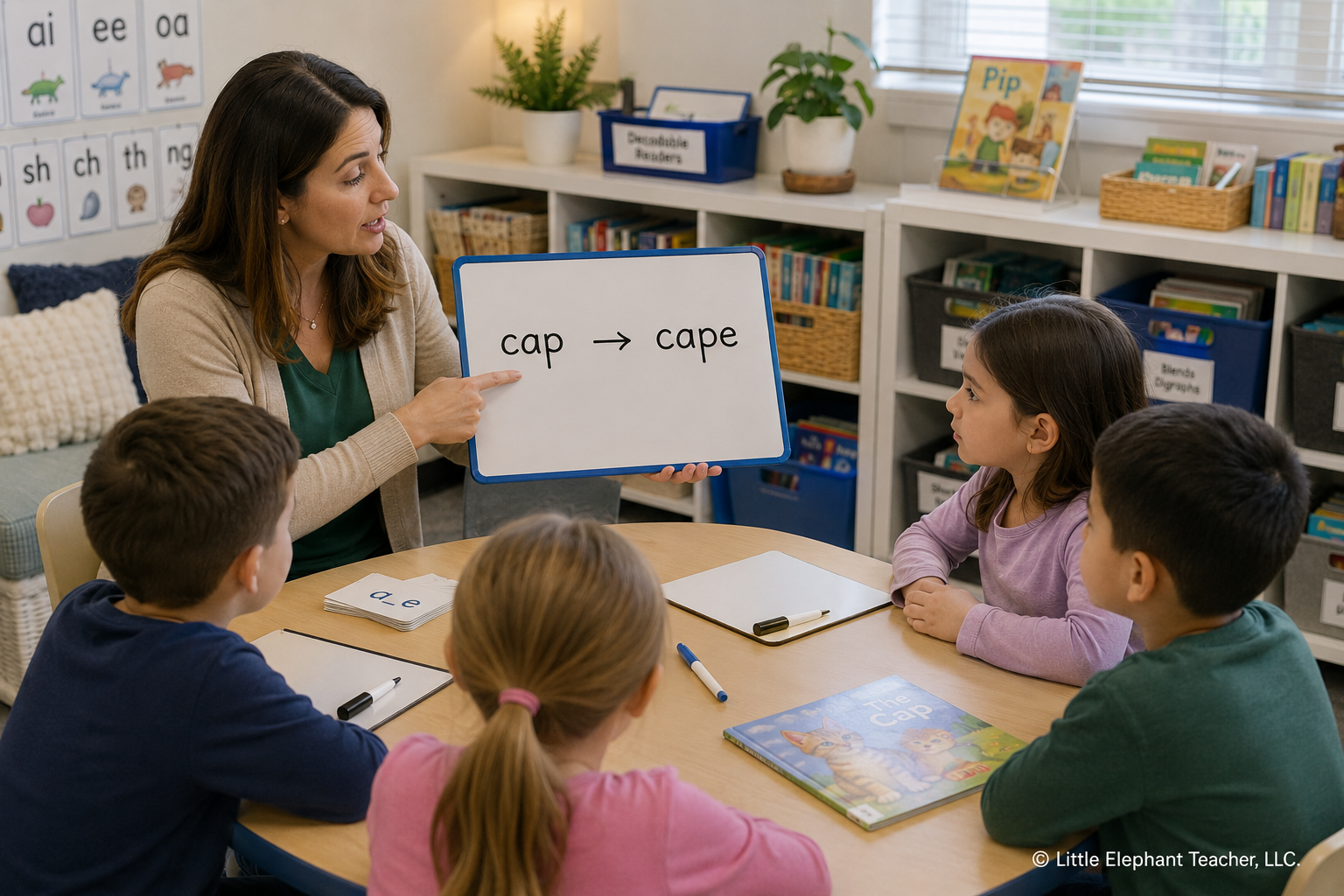
Comparing words such as cap and cape helps students see how silent e changes the vowel sound.
The final e changes the vowel sound, but it is not pronounced.
Students benefit from comparing words with and without silent e because it helps them see exactly how the spelling pattern changes the word.
For example:
cap has a short /a/ sound
cape has a long /a/ sound
Students may sometimes overapply a newly learned rule. A child who has just learned silent e may assume that every final e makes the previous vowel long.
Introduce one vowel-consonant-e pattern at a time and continue providing practice with both short-vowel and silent-e words.
9. R-Controlled Vowels
When a vowel is followed by the letter r, the vowel sound often changes. These patterns are commonly called r-controlled vowels.
Common patterns include:
ar as in car
or as in fork
er as in her
ir as in bird
ur as in turn
The vowel and the r work together to create a new sound.
Students may notice that er, ir, and ur often sound alike in spoken words. This can make spelling more difficult, even after students can read the words accurately.
Word sorting can be especially helpful at this stage. Students can compare words by sound and spelling pattern while building their understanding of when each pattern is used.
10. Advanced Consonants and Silent Letters
Students may next begin working with less common consonant patterns, including words with silent letters and advanced consonant digraphs.
Common silent-letter patterns include:
kn as in knee
wr as in write
mb as in lamb
In these words, one of the consonants is not pronounced.
Students may also learn advanced consonant digraphs such as:
ph as in phone
In the ph pattern, the two letters work together to represent the /f/ sound.
Because these patterns appear less often than basic digraphs and blends, students may need additional practice reading them in words and connected text.
11. Vowel Teams
A vowel team usually contains two vowels that work together to represent a vowel sound.
Common vowel teams include:
ai as in rain
ay as in play
ee as in seed
ea as in team
oa as in boat
ow as in snow
Some vowel teams can represent more than one sound, so students should not be expected to learn every pattern at once.
Teach one vowel team, or a small group of related vowel teams, at a time. Give students opportunities to:
read words containing the pattern
sort words by spelling pattern
spell words using the pattern
read the pattern in sentences and decodable text
For example, students might compare ai and ay words:
rain
mail
train
play
day
stay
This helps students notice where each pattern commonly appears within a word.
12. Diphthongs and Other Vowel Patterns
Many phonics programs next introduce diphthongs and other vowel patterns that do not follow the most common long-vowel patterns.
Examples include:
oi as in coin
oy as in boy
ou as in cloud
ow as in cow
Students may also study patterns such as:
oo as in moon
oo as in book
Some of these spellings can represent more than one sound. For example, ow sounds different in snow and cow, and oo sounds different in moon and book.
These patterns often require explicit comparison and repeated practice. Word sorting can help students notice both the similarities and differences among the patterns.
13. Prefixes and Suffixes
Once students can decode many one-syllable words, they can begin learning how prefixes and suffixes change a base word.
A prefix is added to the beginning of a word.
Examples include:
unhappy
replay
dislike
preheat
A suffix is added to the end of a word.
Examples include:
jumping
helpful
fastest
wishes
Teaching students to identify the base word and any added word parts can make longer words feel more manageable.
For example:
replaying → re + play + ing
Instead of trying to read the entire word at once, students can identify the familiar parts and blend them together.
Instruction should also include spelling changes that may occur when suffixes are added, such as doubling a consonant or dropping a final e.
For additional practice with these word parts, read my guide to teaching prefixes and suffixes during phonics intervention.
14. Multisyllabic Words
As students become more confident with common phonics patterns, they can begin applying those skills to words with more than one syllable.
Examples include:
sunset
picnic
rabbit
hopeful
replaying
fantastic
Students need explicit instruction in how to break longer words into smaller, readable parts.
For example:
sunset → sun + set
rabbit → rab + bit
hopeful → hope + ful
Students can look for:
syllables
prefixes
suffixes
base words
familiar vowel patterns
familiar consonant patterns
The goal is to show students that longer words are not completely new. They are often made up of smaller parts and spelling patterns students already know.
Multisyllabic instruction does not replace phonics. It helps students apply familiar phonics skills to more complex words.
For ready-to-use instruction across this progression, explore my complete phonics intervention lessons.
Supporting Students With Decodable Practice
After a phonics pattern has been introduced and practiced in words, students need opportunities to apply it in connected text.
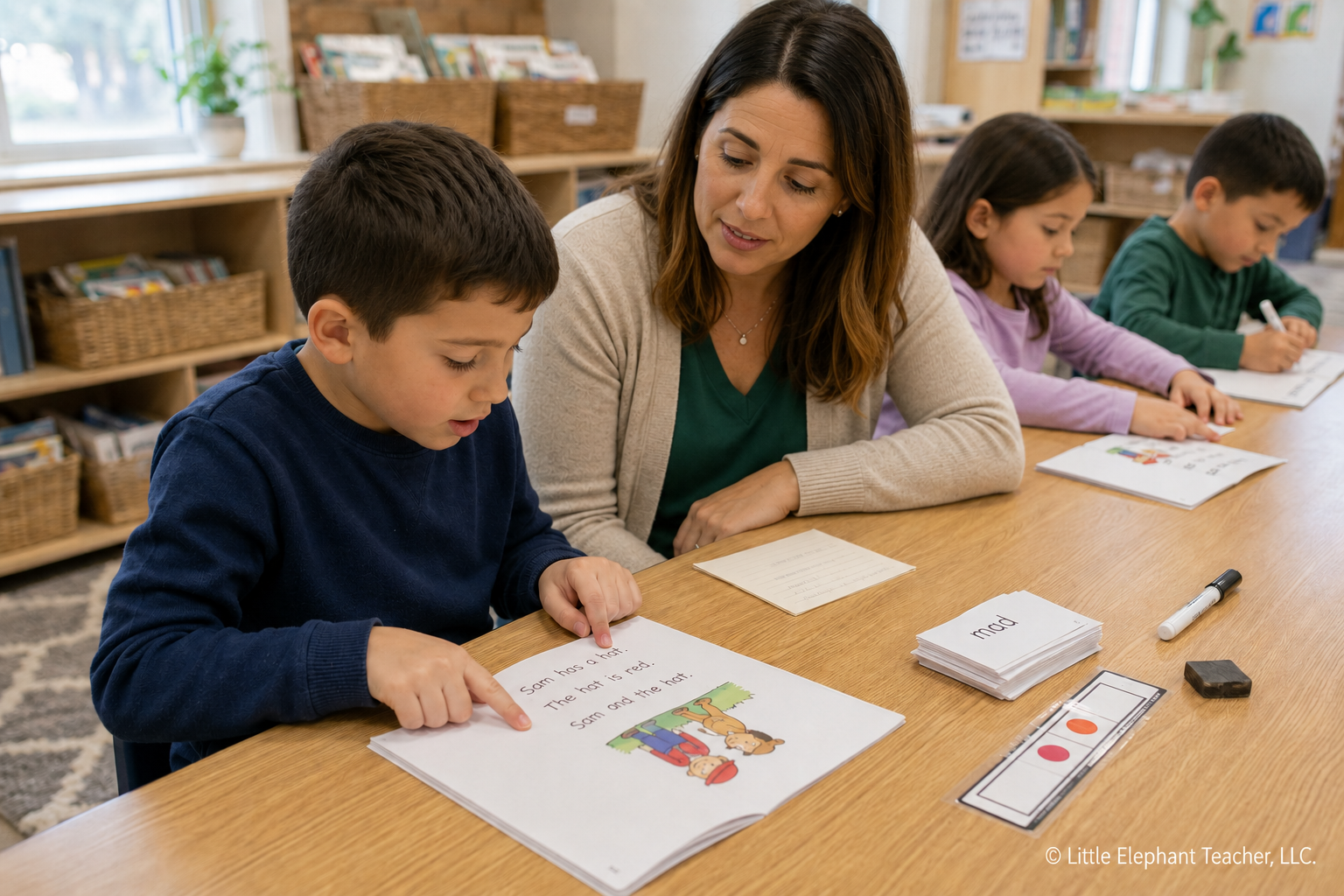
Decodable texts give students a meaningful way to apply the phonics patterns they have already learned.
Decodable passages provide focused practice with words containing patterns students have already learned.
For example, after learning the sh digraph, students might read a passage containing words such as:
ship
shop
fish
rush
This gives students a chance to apply the target pattern while also practicing fluency and comprehension.
Decodable texts should closely match the skills students have been taught. If a text contains too many unfamiliar spelling patterns, students may become frustrated or begin guessing.
During decodable reading practice, teachers can prompt students to:
look at every letter
identify familiar spelling patterns
say the sounds
blend through the word
reread the sentence for fluency and meaning
The goal is not simply to finish the passage. The goal is to help students develop a reliable process for reading unfamiliar words.
You can learn more about using decodable passages to connect phonics skills to reading.
How Do I Know Which Phonics Skill to Teach Next?
Start by using phonics assessment information to identify the earliest skill in the progression that the student has not yet learned securely.
For example, a student may be able to read CVC words but struggle with words containing digraphs. That student may need more explicit instruction and practice with consonant digraphs before moving on to blends or silent e.
Look at whether the student can:
identify the target sound or pattern
read the pattern accurately in words
spell words containing the pattern
apply the pattern while reading connected text
remember the pattern during cumulative review
A targeted diagnostic tool, such as the Quick Phonics Screener, can help you identify decoding strengths and determine where a student’s skills begin to break down.
For a broader look at the types of assessment information you can use, read Diagnostic Phonics Assessments: Getting to the Root of the Problem.
Begin with the earliest area of difficulty, teach it explicitly, and continue reviewing previously taught skills.
Students do not always need to begin at the very start of a phonics program. They need to begin at the point where their understanding becomes incomplete or inconsistent.
You can also use brief phonics progress-monitoring assessments to determine whether students can read, spell, and apply a pattern after instruction.
For struggling readers, the sequence may need to move more slowly. These students often benefit from:
smaller instructional steps
more explicit modeling
additional guided practice
frequent cumulative review
more opportunities to read decodable text
The overall progression does not necessarily need to change. The pace, intensity, and amount of practice may need to change.
Frequently Asked Questions About Phonics Skill Progression
What is a phonics scope and sequence?
A phonics scope and sequence outlines which phonics skills will be taught and the order in which they will be introduced.
The scope identifies the skills included in the program or curriculum. The sequence shows the order in which those skills are taught.
Do all phonics programs follow the same order?
No. Programs may vary in their exact sequence.
Some programs introduce digraphs before the FLOSS rule. Others may teach particular vowel or consonant patterns in a different order.
Most systematic programs still move from simpler sound-spelling relationships to more complex word-reading patterns.
What is the correct order for teaching phonics?
There is not one sequence used by every phonics program.
A common progression begins with phonemic awareness and letter-sound relationships before moving into CVC words, digraphs, blends, silent e, r-controlled vowels, vowel teams, diphthongs, affixes, and multisyllabic words.
The best sequence is systematic, cumulative, and responsive to student assessment results.
Why is phonics skill order important?
Phonics instruction is cumulative. Students need sufficient instruction and practice with earlier skills before they can successfully apply more complex spelling patterns.
A clear sequence helps prevent students from being asked to read words containing patterns they have not yet learned.
Should digraphs or blends be taught first?
Many phonics sequences introduce consonant digraphs before blends.
In a digraph, two letters work together to represent one sound. In a blend, students must hear and retain each individual consonant sound.
For example, sh represents one sound in ship, while both /s/ and /t/ can be heard in stop.
Because blends require students to hold on to multiple consonant sounds, digraphs are often introduced first. However, the exact order may vary by program.
When should students learn blends and digraphs?
Students can begin learning digraphs and blends after they can blend and read simple CVC words with reasonable accuracy.
Continue practicing short-vowel words while introducing these new patterns so instruction remains cumulative.
Should students completely master one skill before moving on?
Students need enough understanding to begin applying the skill successfully, but previously taught skills should continue to be reviewed.
Waiting for perfect mastery before introducing anything new may slow progress unnecessarily. Moving forward before students have a workable understanding, however, can create larger gaps.
Use assessment information, student errors, and performance in connected text to decide when to move forward.
Do struggling readers need a different phonics sequence?
Struggling readers often benefit from the same general phonics skill progression, but they may need a slower pace, smaller steps, more explicit modeling, and additional cumulative review.
Assessment results should identify the earliest point where the student’s skills become incomplete or inconsistent.
What should I do when students have gaps in different areas?
Use assessment results to create flexible instructional groups.
One group may need practice blending CVC words, while another may be ready to work on vowel teams or multisyllabic words.
Small-group instruction allows you to meet students at the point where they need support without requiring the entire class to move at the same pace.
When should students begin reading decodable texts?
Students can begin reading simple decodable texts once they know enough letter sounds to blend words.
The texts should contain mostly previously taught phonics patterns. As students learn new skills, the texts can gradually become more complex.
Decodable reading should begin early and continue throughout phonics instruction.
Final Thoughts
The most effective phonics teaching sequence moves systematically from foundational sound skills to increasingly complex spelling patterns while allowing time for cumulative review.
The exact sequence may look slightly different from one program to another, but the overall goal remains the same: teach skills explicitly, build on what students already know, and provide plenty of opportunities to practice.
When phonics instruction follows a clear and intentional progression, students begin to understand how the English spelling system works.
Instead of relying on guessing or memorizing entire words, they learn how to look at the letters, recognize familiar patterns, and decode words step by step.
Over time, those small decoding successes build the accurate and automatic word recognition students need for fluent reading.
Need lessons and student practice for each stage of the progression?
Explore my complete phonics intervention lessons, which include explicit instruction, decoding and blending practice, word mapping, and opportunities to apply phonics skills in connected text.
Research and Additional Resources
This guide reflects evidence-based recommendations for explicit, systematic, and cumulative foundational reading instruction.
For additional information, visit:
Foundational Skills to Support Reading for Understanding in Kindergarten Through 3rd Grade, published by the Institute of Education Sciences and What Works Clearinghouse
Structured Literacy: Effective Instruction for Students With Dyslexia and Related Reading Difficulties, published by the International Dyslexia Association
About the Author
Andrea Russman is a Title I reading intervention teacher and curriculum designer. She creates practical, systematic phonics resources to help elementary teachers provide targeted instruction for developing and struggling readers.