A student’s hesitation while decoding gives the teacher valuable phonics assessment data about which skill to teach next.
Most teachers can tell when something is not quite clicking in decoding.
You hear the hesitation.
You notice the guessing.
You watch a student get stuck on words they should be able to read.
And then comes the hard part:
What phonics skill should I teach next?
That is where a lot of teachers get stuck.
Without clear phonics assessment data, it is easy to start guessing instruction. We may reteach an entire unit, move too far ahead in the scope and sequence, or spend too much time on memorization instead of figuring out what is actually breaking down.
But here is the good news:
Student decoding errors give us useful information.
When we slow down and look at those errors closely, we can usually see which phonics skill is not yet secure. That is what makes instruction more targeted and more effective.
In this post, we are going to look at how to use phonics assessment instruction and decoding error analysis to decide what phonics skill to teach next in a way that is clear, practical, and aligned with Science of Reading phonics instruction.
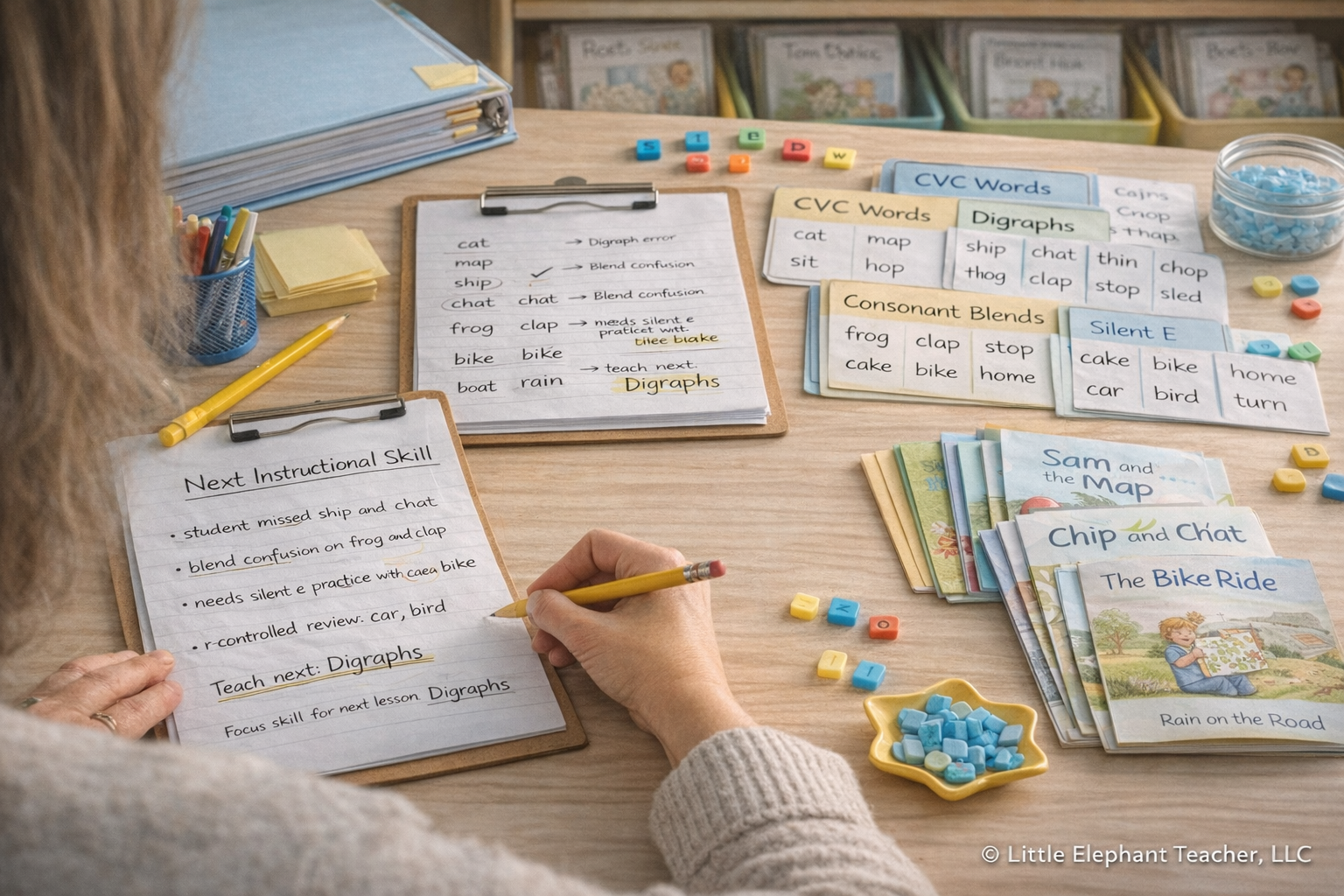
Use phonics assessment data to plan targeted instruction by identifying the next phonics skill students need and matching it to decodable practice.
Start With the First Missing Phonics Skill
One of the most helpful ideas in effective phonics instruction is identifying a student’s instructional entry point.
That simply means finding the first phonics skill the student has not yet mastered.
This matters because when we start too far ahead in the phonics scope and sequence, students often become overwhelmed. They may start guessing from pictures, relying on context, or trying to remember words by sight instead of decoding them.
In other words, if the foundation is shaky, the more advanced skill usually will not stick.
Strong phonics instruction works differently. Instead of starting with the hardest skill, we start with the first missing skill.
A simple phonics progression might look like this:
CVC words → consonant blends → digraphs → silent e → vowel teams
This reflects a typical Science of Reading phonics progression, where students build decoding skills in a predictable and structured order.
For example, if a student has not yet mastered digraphs like sh, ch, and th, then jumping ahead to vowel teams is not going to solve the problem. The student is still missing an earlier skill that supports accurate decoding.
That is why this reminder matters so much:
Teach the first missing skill, not the hardest one.
When instruction starts at the right place, students usually respond much more quickly. They feel more successful, and their decoding becomes more accurate.
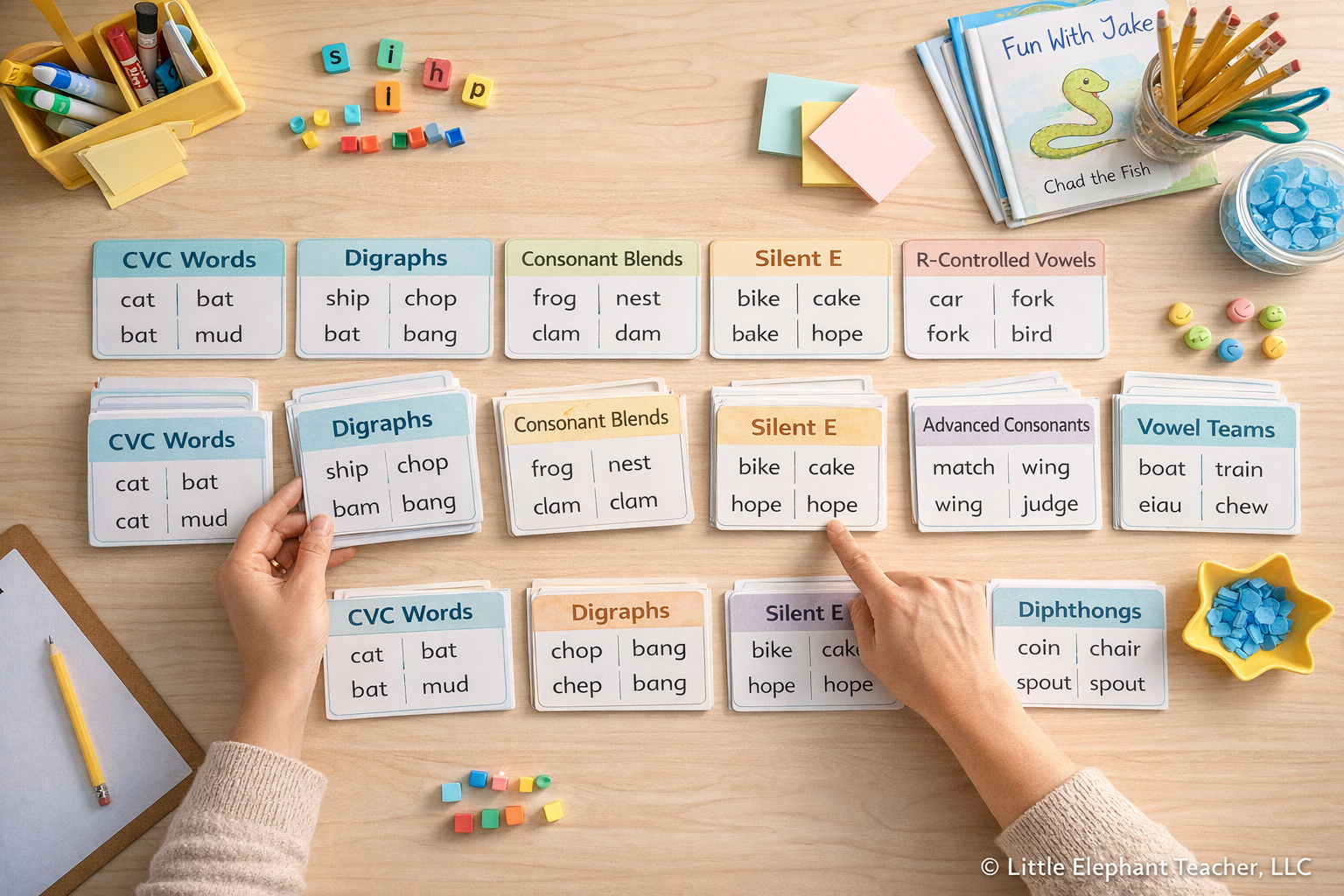
Use phonics assessment data to identify decoding gaps and determine the next phonics skill to teach, from CVC words and digraphs to silent e, vowel teams, and diphthongs.
Look Closely at Student Decoding Errors
One of the most valuable parts of phonics assessment instruction is taking a close look at how students attempt unfamiliar words.
Because decoding errors are usually not random.
They often point straight to the missing phonics skill.
For example, let’s say a student reads:
ship → sip
That tells us something important.
The student is seeing the s and the h, but they are not yet recognizing that sh works together to represent one sound.
That suggests the digraph sh is not yet secure.
So now the instructional response becomes much clearer:
Teach digraphs explicitly.
That might include:
modeling the sound
reading words with the pattern
comparing similar words
practicing with connected decodable text
Here is another example:
chat → cat
Again, the student is not recognizing ch as a digraph.
This is where decoding error analysis becomes so helpful. Instead of just marking a word wrong and moving on, we can ask:
What did the student say?
What phonics pattern was involved?
What does that error suggest the student does not yet know?
When you start looking at student reading through that lens, patterns begin to appear.
And those patterns tell you a lot about what to teach next.
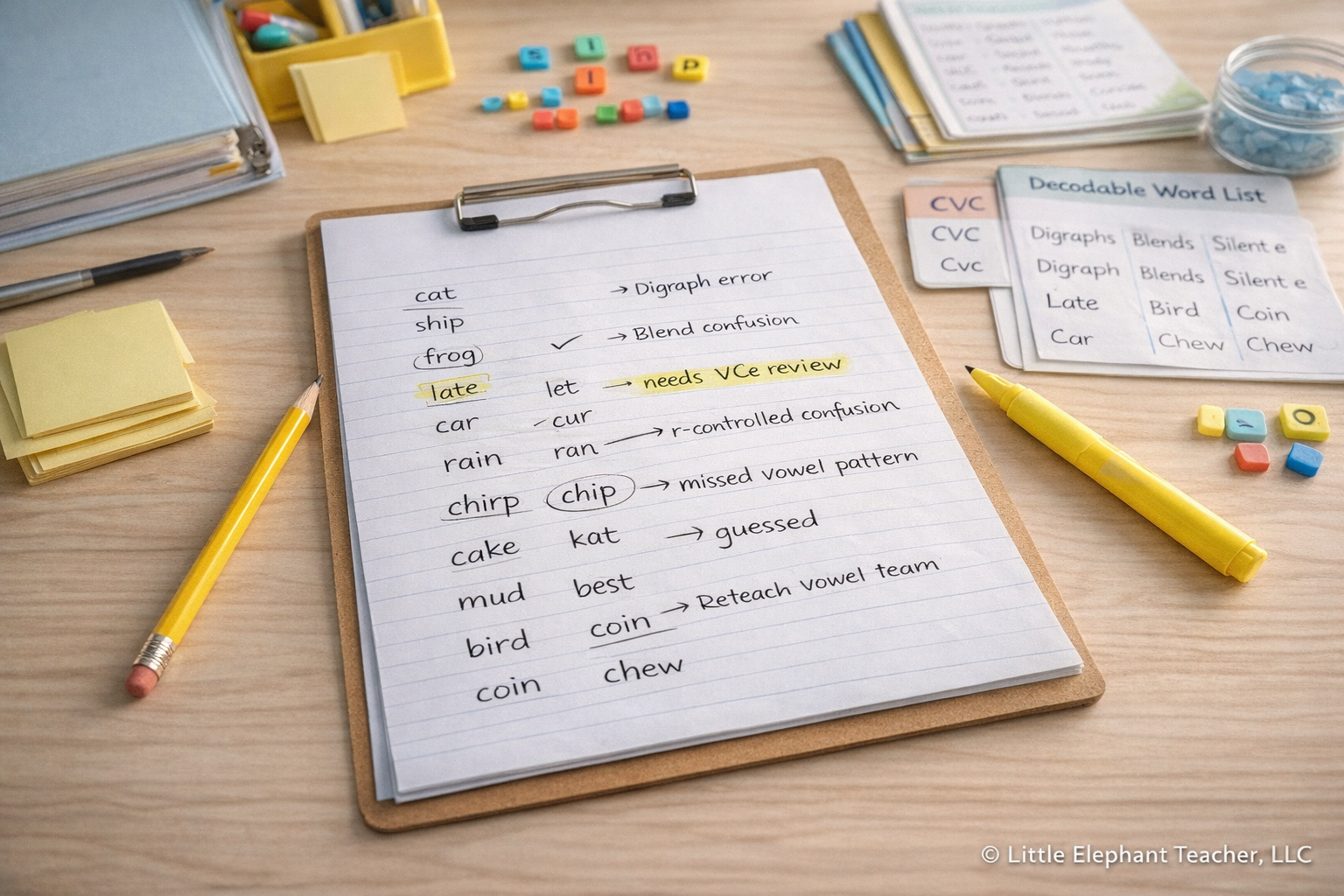
Looking closely at student decoding errors helps teachers identify the missing phonics pattern and decide what skill to teach next.
Separate Pattern Errors From Fluency Errors
Another important part of deciding what phonics skill to teach next is knowing the difference between a skill gap and an automaticity gap.
Those are not the same thing.
A skill gap means the student does not yet understand the phonics pattern.
An automaticity gap means the student understands the pattern but cannot use it quickly and consistently yet.
For example, a student might read:
cape → cap
That usually suggests the VCe pattern is not yet secure. The student is reading the CVC part of the word, but they are not recognizing what the final e is doing.
In that case, instruction should focus on helping the student compare and contrast patterns such as:
cap / cape
kit / kite
hop / hope
That is a pattern problem.
But sometimes the issue is different.
A student might read:
time → t...i...me
That student may actually know the pattern, but the reading is still slow and effortful. That points more to a fluency or automaticity issue than a missing phonics concept.
In that case, the student likely needs:
repeated decoding practice
connected decodable reading
more opportunities to apply previously taught phonics patterns
This distinction matters.
Because if we mistake a fluency issue for a skill issue, we may reteach something the student already knows. And if we mistake a skill issue for a fluency issue, the student may keep practicing the wrong pattern.
The better we understand the type of error, the more precise our instructions become.

Looking closely at student decoding errors helps teachers use phonics assessment data to identify missing skills and choose the next phonics skill to teach.
Use Assessment Data to Plan Instruction
Once you start noticing consistent decoding patterns, the next step is using that information to plan instruction.
It does not have to be complicated.
A simple instructional process works well:
1. Identify the Skill Gap
Look through the student’s decoding attempts and ask:
Which phonics skill seems to be missing?
2. Confirm With Decoding Evidence
Do not base instruction on one error alone. Look for repeated examples.
For example:
ship → sip
shop → sop
rush → rus
When you see the same kind of error multiple times, that gives you stronger evidence that sh is not secure.
3. Teach the Targeted Pattern
Once you know the likely skill gap, teach that pattern directly and explicitly.
That may include:
sound modeling
word reading
word mapping
dictation
connected decodable text
4. Monitor Progress
After instruction, reassess.
Did the student improve?
Is the same error still happening?
Is the pattern becoming more automatic?
This cycle of assessment → instruction → progress monitoring is a key part of effective Science of Reading phonics instruction.
And this is really the heart of the process:
Clear data leads to clear instructional decisions.
Use this during small-group reading or intervention when students make decoding errors.
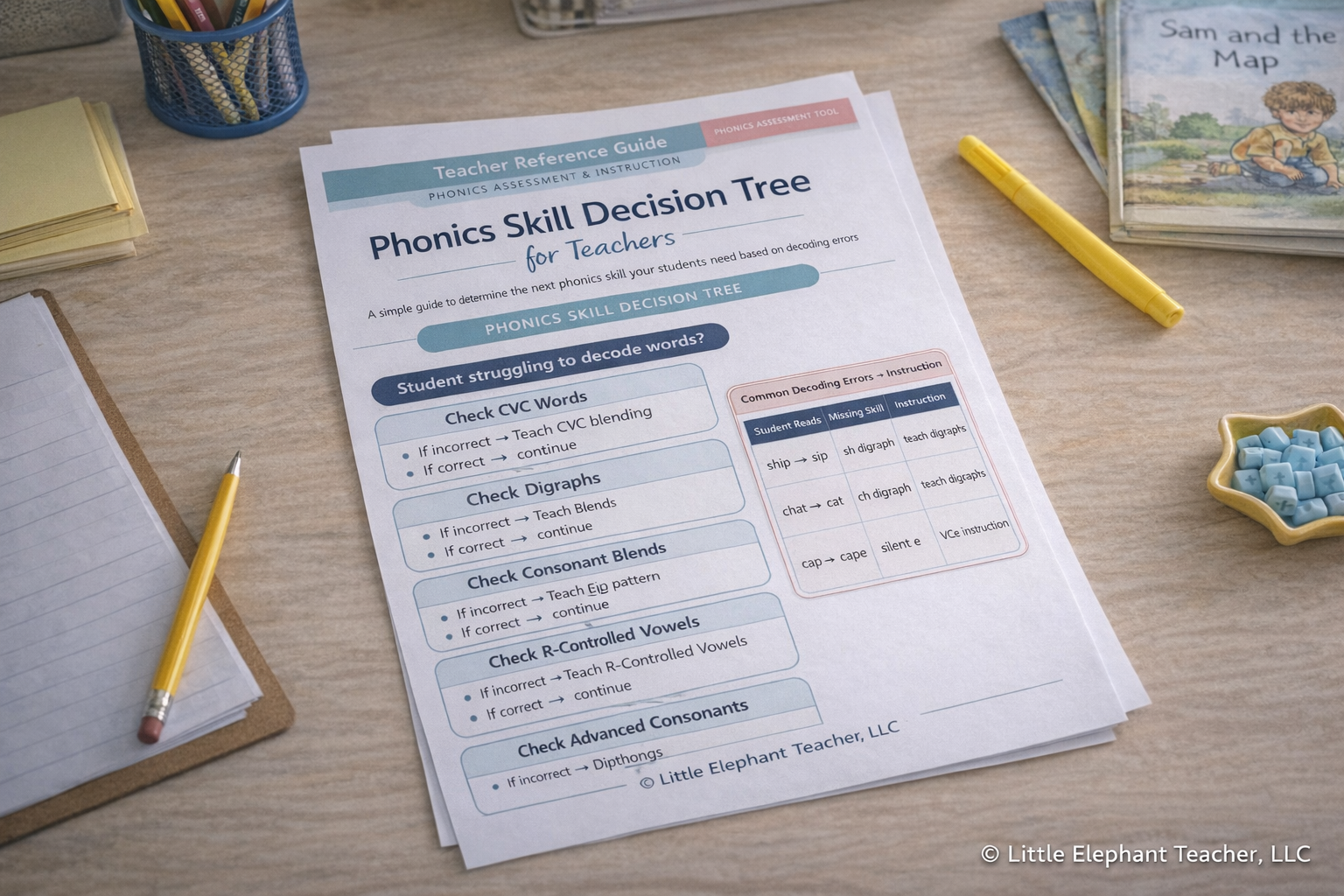
This Phonics Skill Decision Tree for Teachers gives educators a simple printable guide for using phonics assessment data to choose the next skill to teach.
The Most Common Mistake Teachers Make
One of the most common mistakes teachers make is this:
When a student struggles, we sometimes respond by doing too much instead of doing the right next thing.
That can look like:
reteaching an entire phonics unit
moving to a more advanced skill too soon
increasing sight word memorization
giving more practice without identifying the actual skill gap
These responses are understandable. Most of us have been there.
But often, the student does not need more of everything.
They need explicit instruction in the first phonics skill that is missing.
That is why it is so important to come back to the decoding evidence.
Teach the first missing phonics skill.
That is usually what moves reading forward.
This also connects to a bigger issue many teachers run into. Sometimes decoding problems show up because instruction moved too quickly or because earlier patterns were not taught deeply enough.
You can read more about that here:
How to Identify Students Who Need Phonics Intervention
Common Phonics Pitfalls Teachers Don’t Realize They’re Making
FAQ: Determining What Phonics Skill to Teach Next
What phonics skill should I teach after CVC words?
After students can consistently decode CVC words, instruction often moves to:
consonant blends
digraphs
silent e
vowel teams
But the bigger point is this: instruction should be based on student performance, not just the next item in the sequence.
How do I know if a student is missing a phonics skill?
The clearest clue is usually the student’s decoding errors.
For example:
ship → sip
chat → cat
Those types of errors suggest the student is not yet secure with digraphs.
Should I reteach an entire phonics unit if students struggle?
Usually, no.
In many cases, the student needs targeted instruction in one specific phonics pattern, not a full unit review.
What if a student knows the skill but reads slowly?
That may be an automaticity gap rather than a skill gap.
In that case, the student likely needs more practice applying the skill in reading, especially through repeated word reading and connected decodable text.
Final Takeaway
Strong phonics instruction does not come from guessing.
It comes from looking closely at data and listening closely to student decoding.
When teachers analyze decoding errors and identify the first missing phonics skill, instruction becomes more focused, more efficient, and more effective.
That is really the takeaway:
Clear data leads to clear instructional decisions.
If you want to keep digging into this work, these posts may also be helpful:
How to Identify Students Who Need Phonics Intervention
How to Use Phonics Data to Drive Instruction (Not Just Grouping)
Want to Know Exactly What to Teach Next?
One of the most powerful shifts teachers can make is learning how to interpret phonics assessment data with confidence.
When teachers understand how to analyze decoding errors, they are better able to:
identify instructional starting points
plan targeted phonics instruction
avoid common phonics pitfalls
monitor progress with more confidence
Inside the Phonics Assessment Course, I walk through this process step-by-step.
The course helps teachers learn how to:
interpret phonics assessment data
identify missing phonics skills
determine the correct instructional entry point
plan effective phonics instruction aligned with the Science of Reading
When teachers feel more confident reading the data, it becomes much easier to make strong instructional decisions.
Andrea is an elementary educator and the creator behind Little Elephant Teacher® LLC., where she supports teachers with practical, research-aligned phonics instruction. She is passionate about helping teachers confidently use phonics assessment data, analyze decoding errors, and make clear instructional decisions rooted in the Science of Reading. Through her resources, courses, and classroom-tested strategies, Andrea helps teachers bridge the gap between phonics and meaningful reading success for every student.